GRACE UNDER PRESSURE
  • Blog
  • About
  • Pennies
  • Act Now
  • Contact

​​


TRAINING DAY 8: NAVIGATING UNDER A TOWEL

5/28/2014

Comments

 
Today was fun (...even though we were reviewing some serious emergency situations). We started in the classroom reviewing drills we'd do in the water, including how to use the marine VHF radios and safety sausages (brightly-colored, inflatable buoy columns) we'll always have with us underwater. We all got a little competitive during the emergency drills, which kept everyone's attention piqued. 

In the first drill, we practiced navigating with a compass. To make sure we weren't cheating, the instructors put towels over our heads (Mission 31 monogrammed towels, of course), so we had to "blindly" rely on only our compass heading to get where we wanted to go. I'm sure this looked ridiculous to anyone who passed by, but we're all now great at navigating! 
Picture
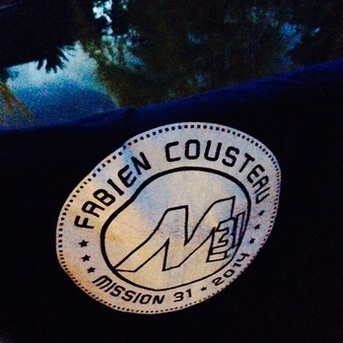
Mission 31 towel. It's white on navy; classy!

Picture
We also drilled a worst case scenario in which both divers are disoriented and lost their masks. Our goal was to return safely to the habitat. To do this, we attached our secondary reel of rope to a stationary point on the seafloor and used the line to swim in a circle (in a constant radius) around the stationary point looking for one of the neon excursion lines that led back to the habitat (all without masks). Initially the drill was complicated; but practicing it first on land really helped. In the water, Liz and I nailed it. Liz described in her Girls's Rule blog post: "It was a good feeling to be on the same page as my dive buddy Grace, especially considering we are about to spend over 20,000 minutes underwater together! I have a feeling that by the end of the Mission, Grace and I will be able to read each other's minds underwater." 

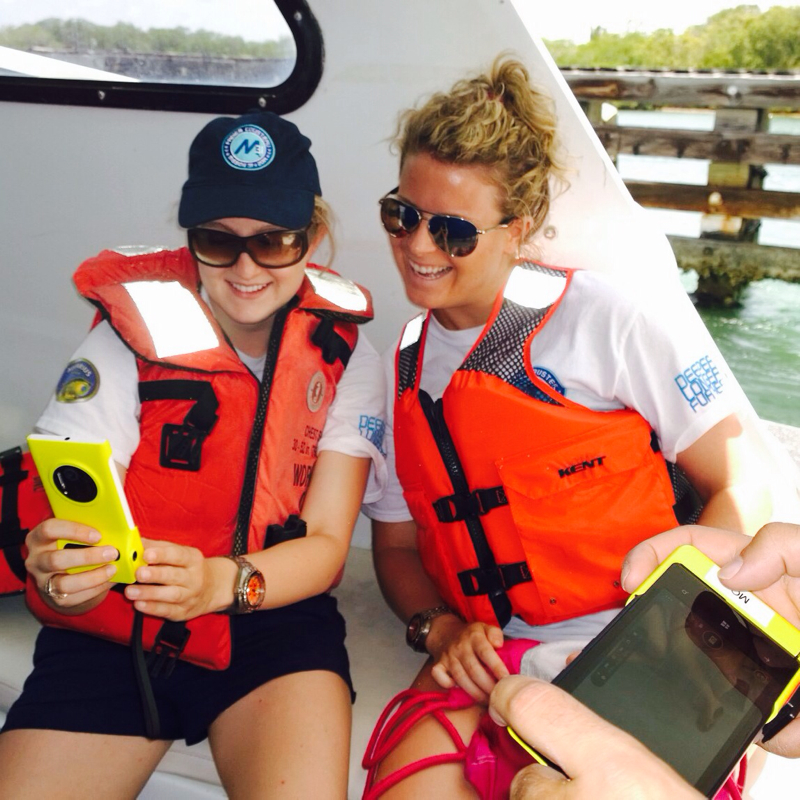
Billy Snook, a member of the Mission 31 production team, filmed us underwater today with a Nokia (one of our sponsors) Lumia 1020 camera. Thanks to Billy and Nokia for the photos and video clips bleow!  

Here's a video of today's underwater training 

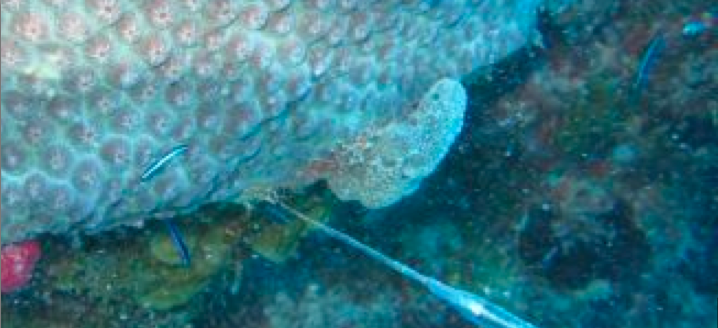
and here's some sea life we saw today

and photos from the boat

Picture
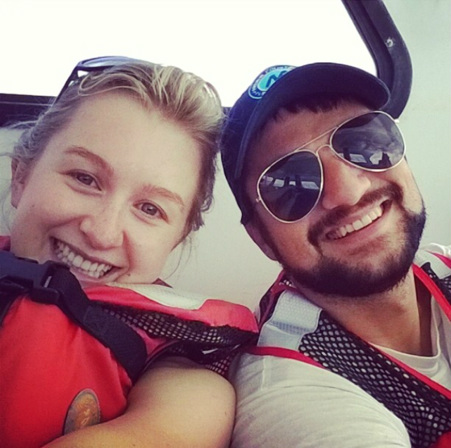
Fellow aquanaut Adam and me, taking a selfie on a Lumia phone from our mission sponsor Nokia.
Picture
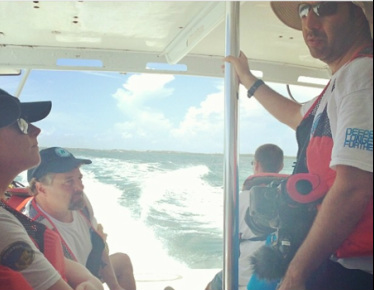
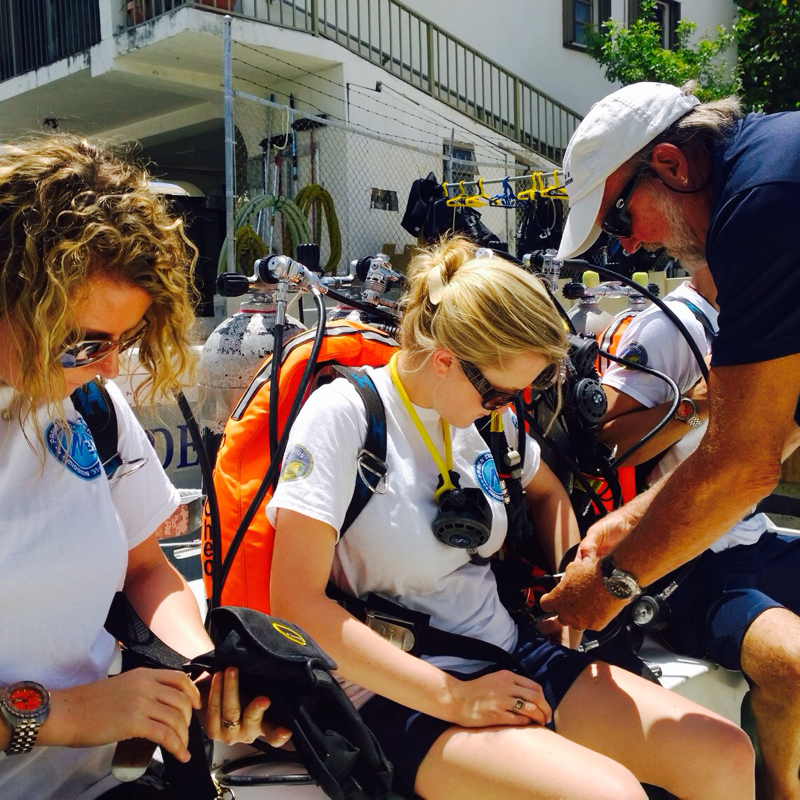
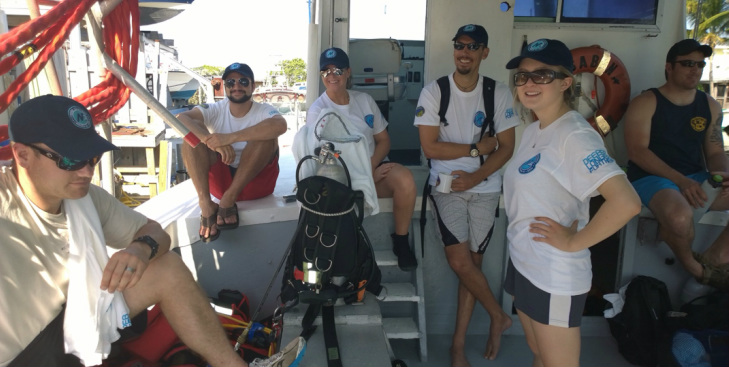
The boat was full today, including aquanauts, camera crew, and Navy support divers. In this photo, from left to right: Liz (aquanaut), Billy (camera), Andy (aquanaut), and Marc (camera).
Comments

TRAINING DAY 7:  OTTER AND OTTO; LET'S GET REEL

5/26/2014

Comments

 
Two Aquarius dive masters named Otter and Otto ran our training today. We again started in the classroom and finished in the water. We took a virtual tour of Aquarius and then had safety briefings on emergency drills for the habitat. Emergency situations for the habitat include getting lost, running out of air, receiving contaminated air, flooding, and fire. A fire underwater might seem like a firefighter's dream, but it's not; a fire could devastate Aquarius wiring and/or the habitat from inside where there is 2.5 times more oxygen than on the surface. We'll run through habitat safety drills again throughout this week. 
Picture
It's another gorgeous day in the Keys!
Picture
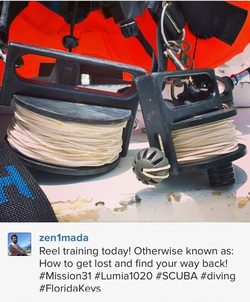
Excursion reel lines (i.e., ropes) are used underwater to find way back to the habitat. Photo credit Adam Zenone.
Picture
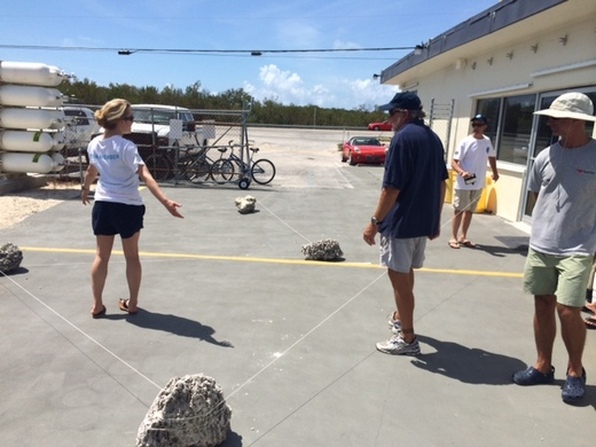
There's so much blue undersea, it can be disorienting! Here we're practicing safety drills using a reel line (rope) to navigate and find our way back. See the line around the rocks? Good thing we practiced these emergency drills on land before water. Photo credit to Liz Magee.
This afternoon we dove with double tanks again near Aquarius. Double air means more time to work in the water, so we'll use double tanks whenever we're not using the dive helmets. Otter and Otto ran us through the drills we discussed earlier in the classroom, including extending and recalling excursion lines (i.e., ropes we can follow back to the habitat), searching for a lost buddy diver, buddy breathing while swimming, and turning on/off all the valves on our tanks with our masks off. We all did ok. It's a bit hard to get used to swimming with two heavy tanks on your back plus all the extra gear, including two reels, knife, extra regulator, slate, radio, strobe light, and a safety sausage (an inflatable, bright-colored column). 
In the evening we headed back to mission headquarters for home-made pizza! Tomorrow we'll train longer underwater with more mask-off drills, so I expect my eyes to hurt. 

Comments

TRAINING DAY 6: DOUBLE TANKS, HALF THE TROUBLE

5/26/2014

 
My favorite part of the classroom session today was learning about what we can pack. For some odd reason, I've always loved packing for trips. All of our stuff going to Aquarius gets there in pods delivered by Navy divers, so it goes from 1 to 2.5 atmospheres of pressure. That means anything slightly toxic on the surface is 2.5 times more toxic in the habitat (and there's twice as much O2!). For this reason, we're extra cautious about fire hazards and are advised not to use scented products (like antiperspirant) that have toxins in them. Otter told us a fire once started from a Pop-Tart in the microwave!
Picture
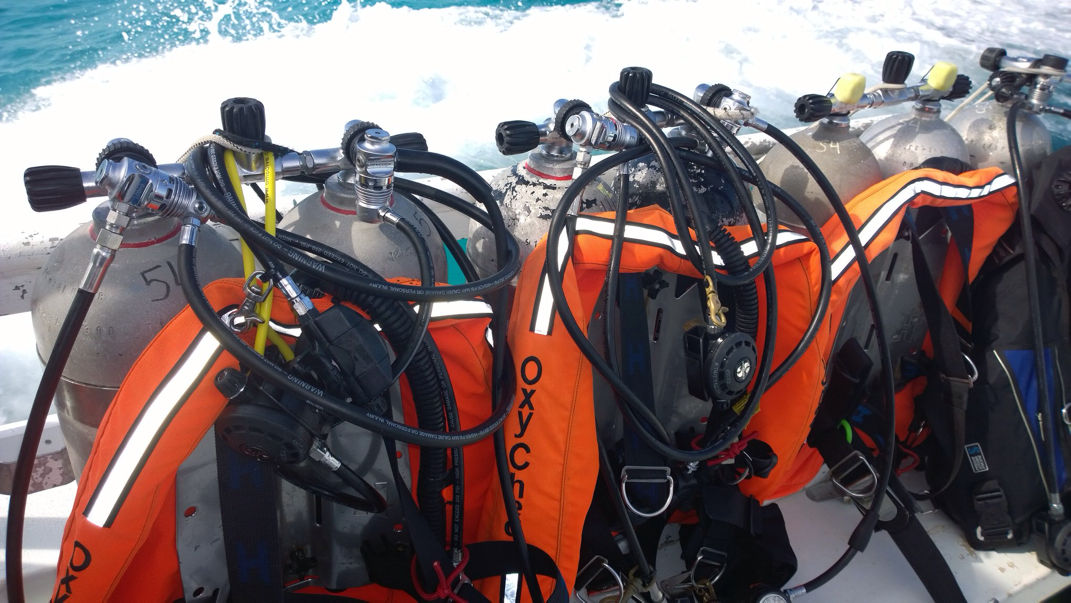
Our dive gear set up, ready to go. Double tanks mean double air, so more time in the water to do research. We'll use double tanks whenever we're not using dive helmets. Photo from fellow aquanaut Kip Evans.
Otter, a former Navy diver and our classroom instructor today, reiterated the importance of safety. We reviewed what to do if we get lost, separated from our dive buddy, run out of air, have equipment malfunctions (from regulator failure to loss of a flipper), or fire breaks out. By the end of the week we'll know how to deal with all imaginable emergencies.

It's easy to become disoriented underwater; sometimes everything around you looks blue! When we're in the diving helmets, we're always able to follow our air-carrying umbilical cord back to the habitat. While we're in SCUBA gear, we can follow excursion lines (i.e., ropes) leading back to Aquarius.

In an emergency while saturated, your instinct shouldn't be to go to the surface, but back to the habitat. Rushing to the surface while saturation diving is as dangerous as rushing to the bottom of the ocean from land; your body doesn't have time to adjust to pressure differences without careful procedures.

We must also remain cognizant of our surroundings. Visibility (how far you can see underwater) can change on the reef from 100ft to 10ft in a few minutes, meaning one moment you can see your dive buddy next to you and the next she's out of sight. If we ever lose sight of our dive buddy, we need to do a quick circle-swim to look for them and then head back to the habitat to send out a search party. There's always a standby diver in the habitat ready to jump in the water and assist in any sort if rescue.

Running out of air is almost always caused by lack of dive-planning or diver carelessness. All the aquanauts are experienced divers so we're not going to let this happen, plus one of the habitat technicians will also track every dive. He said if we return from a dive as much as a minute later than planned, the search party will deploy. That said, we still practice what to do in case we run out of air! Like I said, we're preparing for every imaginable emergency situation. In case a diver is out if air, they would buddy breathe or use the alternate regulator of their dive buddy. We also tested our respiratory stamina in the pool. We need to know how far we can swim on a single breath so we know our limits. We'll always plan our dives to return to Aquarius with at least 500 psi in our tanks, so if something unexpected happens we'll have enough air to deal with it.

Practically all our gear has fail-safe mechanisms; e.g., on SCUBA we have two regulators with us, two tanks, three ways to inflate/deflate our buoyancy control device, three ways to signal for help (radio, strobe, and inflatable), so in the rare case one failed, we've a backup, or our buddy's extra. It's rare that gear fails, however, but we're prepared for anything.

Kindergarteners I spoke to recently asked me, "What if a shark ate your mouthpiece? What if a shark bit your tank? What if you tripped on a turtle?" With all the fail-safes on my gear and emergency scenario training, I can deal with all those situations. 

Apparently the most common medical issues while saturation diving are ear infections and infected cuts. The habitat technicians are trained dive-medical officers so they're prepared for everything. We also need to be aware of hyperthermia. The water feels warm, slightly over 80 degrees, but swimming for three hours (like we'll be doing) can wick away your body heat and lower your body temperature below its normal 98 degrees.

We also claimed Aquarius bunks today. There are two stacks of three bunks. The technicians need the lower bunks so they can get out of bed quickly to fix things. Fabien called the middle starboard bunk because he's left handed. Liz and I wanted top bunks; she's left handed and I'm right handed so we'll split starboard and port. We're a team made in heaven! 
Picture
Liz and I checking out photos on new phones from Mission 31 sponsors, Nokia.
Picture
Otter helping me try on the gear for fit. Liz is next to me trying on gear as well. Photo by fellow aquanaut (and National Geographic photographer) Kip Evans.
After lunch, we dove in the double tanks, like we'll do from Aquarius. The dual tanks are tricky to get use to because they're so heavy, but the advantage is we'll carry enough air to dive for several hours. We got the hang of swimming with them, however, and aced the practice drills, including shutting off, turning on, isolating and de-isolating the tanks, practicing buddy breathing, and doing flips and turns to show that we're comfortable in the new gear.
Picture
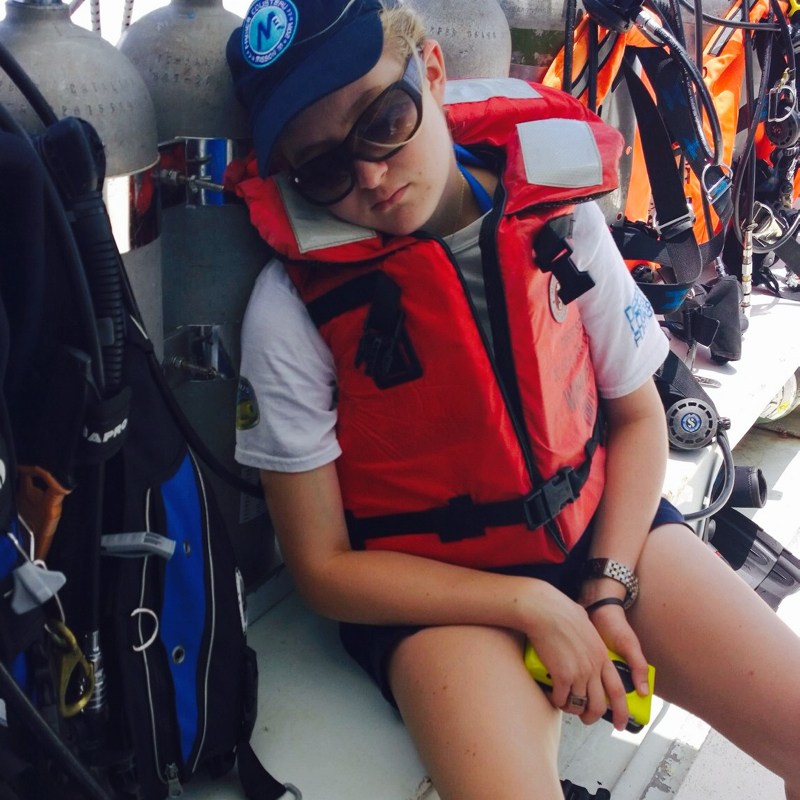
Kip caught me falling asleep on the hour long boat ride to our dive spot.
Picture
Just after dinner, the production team uploaded the first video of our training week!  Check it out: http://m.youtube.com/watch?feature=youtu.be&v=fb9W_WQL9Lg 

SUNDAY, CATCH UP & REST DAY

5/25/2014

 
Today is a rest day. We're having a cookout tonight with the whole crew, including Navy divers. It's going to be fun. Tomorrow, part of the production team will leave us for two weeks of filming in the Amazon for a piece by Fabien's sister Celeine -- I can't wait to hear their stories when they return!

Picture
Today I tried on for fit the full face masks we'll use for SCUBA this week. The mask has a microphone and speakers in it that will allow us to communicate underwater.
Last night, we went to an great lecture by Bob Croft at the History of Diving Museum.  He was a Navy diving instructor and the first person to free-dive beyond 200 ft deep. He said, "You really don't need to breathe as often as you think you do." 
Picture
Singed copy of Bob Croft's book: Father of American Freediving
Picture
Mission 31 aquanaut photo shoot. Photo credit to Marc Ostrick.
Picture
Camera equipment testing this week in pool. Photo credit Changing Tides Media.
Picture
The History of Diving Museum highlights Mission 31 science research advisor Mark Patterson. That's his signature across the top!

SCIENCE SATURDAY: MISSION 31 RESEARCH PROJECTS

5/24/2014

 
This morning mission scientists (Adam, Andy, Liz, and I) reviewed all the research experiments with the rest of the Mission 31 team. Researchers from Northeastern also joined us on a conference call. "Mission scientists" aren't the only scientists involved in this mission. Dozens of other scientists and technical advisors are participating by providing knowledge, expertise, research equipment, and other resources. From Northeastern, for example, five graduate students designed experiments for the aquanauts to conduct. Other researchers will also assist us via regular surface dives in the work that don't require saturation diving. See What's Mission 31 All About? Understanding M31 Ocean Research [video] in my blog. 

The Big Take-Away

The big take away here is that we are conducting research that isn't possible without Aquarius, the world's only undersea laboratory. It would take a normal diver six months to collect the amount of data that the aquanauts can obtain in 31 days. Specifically, we're researching: 
  • Coral reef health
  • Goliath grouper feeding behavior 
  • Zooplankton 
  • Barrel sponges
  • Environmental contamination

The Team

Science research during the first half of Mission 31 is run by Florida International University (FIU), and by Northeastern University (and me, from MIT) during the second half of the mission. For the second half, Liz and I are aquanauts working with a large team, including: 
Principal researchers: Mark Patterson, Brian Helmuth, and Loretta Fernandez 
Graduate students: Amanda Dwyer, Alli Matzelle,  Jessica Torossian, and Nick Colvard 
Technicians: Francis Choi and Sara Williams
Media and Outreach coordinators: Morgan Helmuth, Amanda Padoan, Angela Herring, Ursula August, and Kara Sassone 

The Science Details

Picture
Micro-electrodes will help us periodically monitor the health of the coral reef (Image credit: Unisense)

Coral Reef Health

Our research will help answer: How do corals respond internally to daily fluctuations in external temperature, light, pH, and dissolved oxygen? The topside team will insert Unisense electrodes into three coral polyps per colony underwater to measure the gastrovascular system (the gut) of the corals. Data collected 24/7 over two weeks, creating the first long-term data set from wild corals. In addition to the data from the electrodes, Liz and I will measure corals' photosynthetic performance with a PAM fluorometer.

Picture
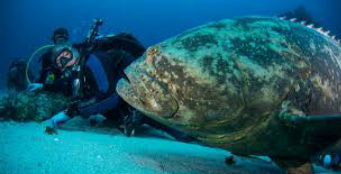
We'll study the goliath grouper's unique feeding behavior (Image credit: Alan Egan)

Goliath Grouper

We'll record unique predatory behavior of the goliath grouper using a state-of-the-art high-speed Edgertronic camera. The results could validate the unproven theory that Goliath Groupers use the sound of a collapsing cavitation bubble formed in their head as a weapon to stun their prey. It'll help answer: What is happening during a grouper's feeding strike, and does the grouper use sound as a weapon?
Picture
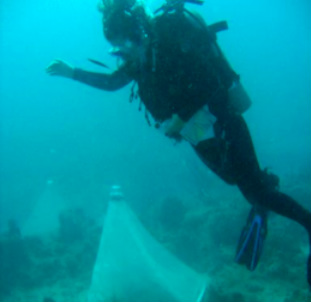
We'll collect zooplankton samples using nets to measure their health and abundance.

Zooplankton

Every day we'll collect small samples of zooplankton with nets to quantify their presence on the reef. The data will help scientists answer: How are plankton communities changing with climate change? In addition, the ratio of alive to "zoombie" (recently dead, but not broken down or consumed yet) zooplankton in our samples will give insight into the populations and lifespans of these creatures, which are necessary for coral reefs to be resilient against coral bleaching events. 
Picture
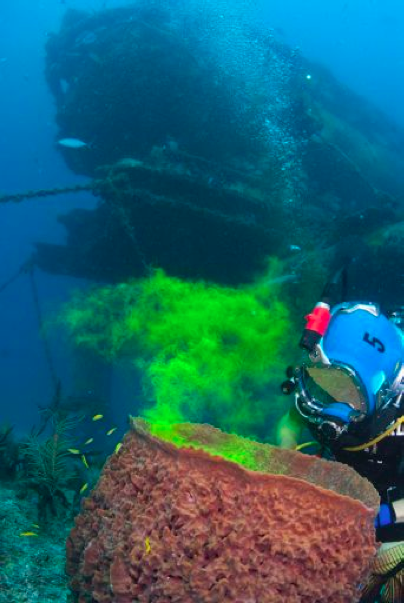
Giant barrel sponges, like that in the photo, filter water. We'll study their behavior using sensors to measure their metabolism.

Barrel Sponges

Sponges are prodigious filter feeders. They filter water equal to their entire body volume in less than a minute and remove more than 99% of the particles they inhale, most of which are bacteria. Part of the reason visibility is so good on a coral reef is becuase of the filtering by sponges. We are looking to answer the following research questions: How do barrel sponges filter material and how can we model their behavior? Does their behavior fluctuate over the course of a day in a predictable pattern (circadian rhythm)? Are neighboring sponges pumping at the same rate or is every sponge different? We'll answer these questions using sensors that measure fluctuations in temperature, salinity, pH, dissolved oxygen, and flow over the seafloor and in the water coming out of the sponges. From these measurements, the Northeastern researchers can study how sponges' metabolism and feeding rate respond to changes in the environment. We'll also collect DNA from 14 different sponges for the Ocean Genome Legacy Project.     
Picture
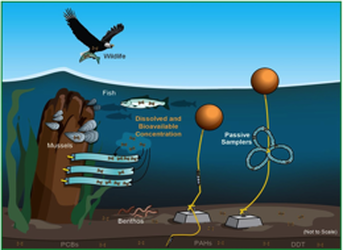
We'll deploy and recover sensors that will measure environmental contaminants on the reef.

Environmental Contamination

We'll deploy and recover sensors that absorb and measure environmental contaminants, including PCBs, PAHs, and potentially dispersants from the BP oil spill. They will help us answer: What environmental contaminants are in the coral reef? Based on the findings, Dr. Loretta Fernandez can model contaminants in the area and refine methods for measuring them. 
In addition, Florida International University has planned a number of experiments to conduct during the first half of the mission. We expect the Mission 31 will produce much valuable data and many research papers! 

Continue reading. More Grace Under Pressure blog posts here.

AQUANAUT TRAINING DAY 5: NAVY'S FASHION ADVICE

5/23/2014

 
Today we started promptly at "eight hundred," as the Navy divers say, and headed back to Aquarius with the Kirby Morgan diving helmets. It's our last of training day in the helmets, so we all should be very comfortable in them. The plan is to dive in pairs back to Aquarius for 30 minutes each. My goals today were to trim my weight just right so I'd be neutrally buoyant on the seafloor, practice climbing around the habitat underwater without flippers, get used to keeping my head back (with the heavy 30lbs helmet) underwater so I'm more balanced and air doesn't leak from the neck seal, and to be conscious of the umbilical cord so it doesn't get tangled or caught too often. I also need to remember to speak clearly in the communication device inside the helmet. Interestingly, the communications system filters out (to an extent) high-pitch background noises and sometimes Liz and my voices reach just that high-pitch frequency so they get cut off. It's not a major issue; if I don't hear a response I'll just repeat my message, but still it's something to be aware of. 
Picture
The empty dive vest and tank in the center is for the stand-by diver; every time we go on a training dive, a Navy diver sits there, ready to get in the water at any moment for an emergency. Heading to Aquarius on the boat, left to right: Carter (Navy diver), Adam (aquanaut), Liz (aquanaut), Andy (aquanaut), me (aquanaut), and Hunter (Navy diver). Photo credit to Fabien Cousteau.

Welcome "Back" to Aquarius 

Picture
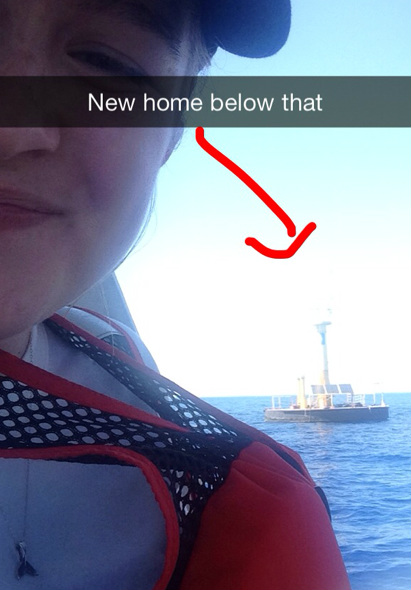
That buoy/power control tower floats directly above Aquarius, the underwater research habitat and marks the spot.
Picture
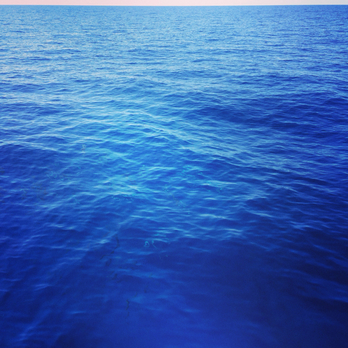
No filter! The water was just this clear and gorgeous. See those faint shimmery squiggles in the water? Those are barracuda.
I felt like a superhero being "weightless" underwater, jumping up and over the Aquarius habitat, which is like jumping over a two story building. I also took off my flippers and walked on the edge of the habitat like a tightrope walker. The Bonnet Rogue SCUBA divers caught my ballet "acrobatics" on video, but that footage won't come out until later! It turned out that I didn't need any added weight to reach neutral buoyancy on the seafloor. I also felt like I got the hang of swimming with the extra 30lbs on my head.  

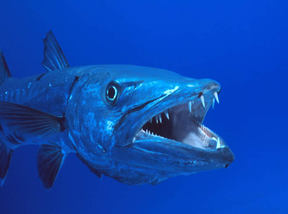
I stared eye-to-eye with a barracuda for what seemed like a few minutes. They are a fearsome-looking fish, known for their scary appearance and teeth, but getting scared is one of the worst things you can do underwater because you might hyperventilate, lose control of your buoyancy, etc. Besides, barracuda will only bite if you look/smell like a fish. With bubbles streaming out of my Kirby Morgan and a tank strapped to my back, I don't look like a fish. 
Picture
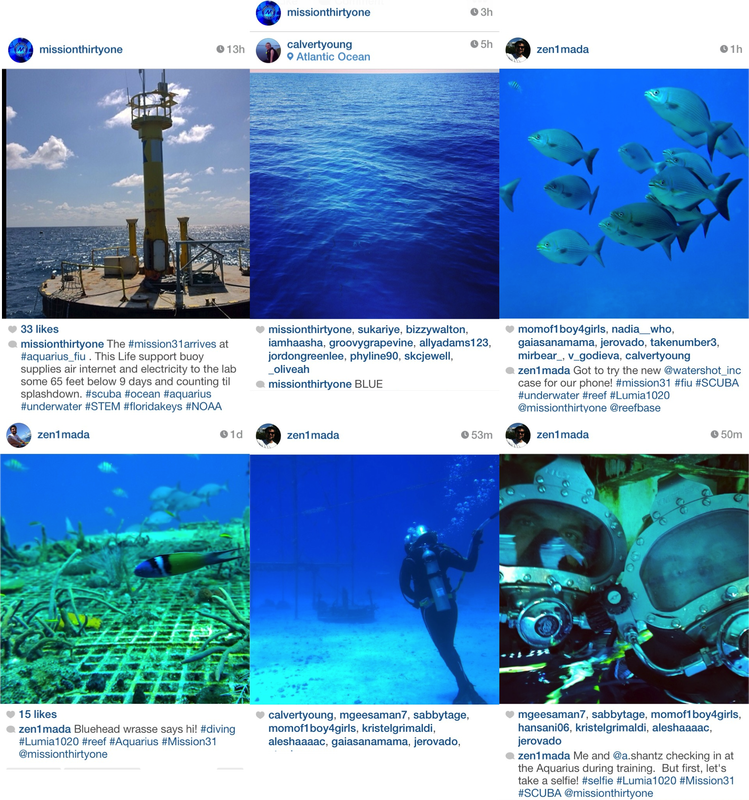
Instagram updates from the dive today. Beautiful!
Picture
The neck seal on the dive helmet is pulling on some of my (long) hair, so I need to be better braiding it out of the way. One of the Navy divers, however, recommended that I go for a 2 mm buzz cut ... that's not happening. I'm not ready to take fashion advice from the Navy.

Picture
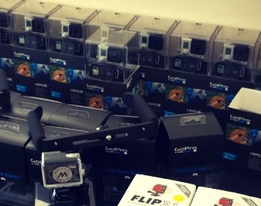
Mission31 custom GoPro kits from Backscatter. Photo credit Changing Tides Media.
Picture
Look at those teeth! A barracuda and I had a staring contest around Aquarius today.

Afternoon Outreach

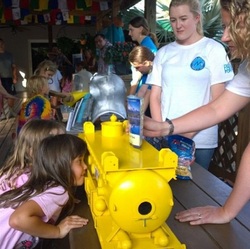
After training, Adam, Liz and I visited the local Montessori school's science night to tell them about Aquarius. We showed them the model of Aquarius with a LEGO aquanaut and let them try some freeze dried foods we'll be eating underwater (think astronaut food). It was so fun! Many of the kids were familiar with Aquarius because it's basically in their backyard. 
Picture
Students tasted freeze dried food that we'll eat in the underwater habitat.
Picture
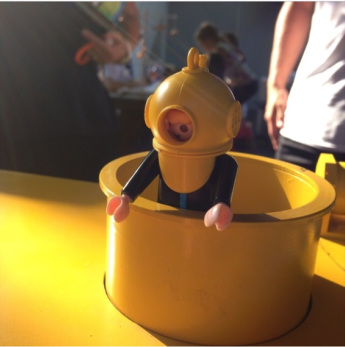
Friday science outreach. LEGO auquanaut on the Aquarius model.
Picture
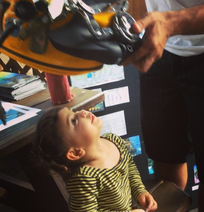
This lucky girl got to try on a dive helmet with Adam at the outreach event today. Aww...

A Good End to the Week 

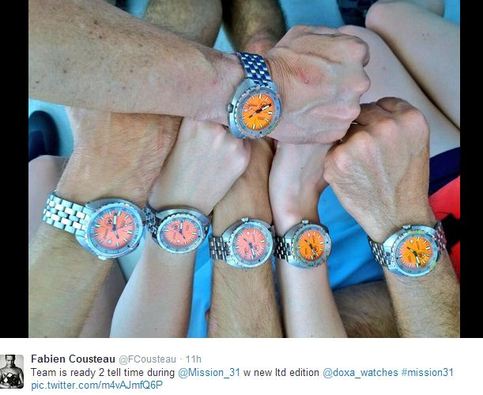
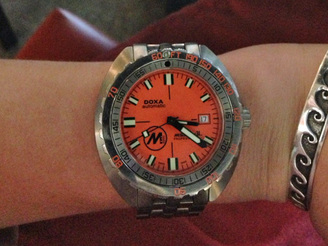
Before dinner with the crew this evening, we took a group photo with all the aquanauts, wearing our new gear from Oceanic. Also, Fabien brought us together for a surprise gift... He loaned us each limited edition Mission 31 DOXA watches! 
Picture
Orange is the new black. Doxa limited edition Mission 31 dive watches.
Next week is the final week of training. We'll focus on SCUBA and the details of Aquarius, and a Navy doctor will pull each of us aside for a final check to make sure we are fit for saturation. Safety is of paramount importance, so it's still possible any of us could fail the final check and not be allowed to saturate. Astronaut Ken Mattingly learned 3 days before Apollo 13's launch that he would not go because he was exposed to measles. If any of us for any reason is no longer able to saturate we could still aid the operation and research from topside, and even SCUBA dive down like other support divers. 

Saturday we'll be up early to review Mission 31 science research plans! 

IT'S WORLD TURTLE DAY: SHELLEBRATE!

5/23/2014

Comments

 
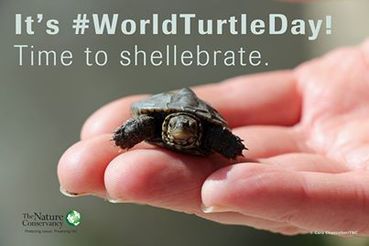
It's World Turtle Day!  All sea turtles breathe air (like SCUBA divers!). Many sea turtles fatally mistake plastic garbage bags as jellyfish food.  With ocean garbage on the rise, using recyclable bags instead of plastic is a great idea.
Picture
Image credit The Nature Conservancy.
25 Selfies to Celebrate World Turtle Day!
Picture
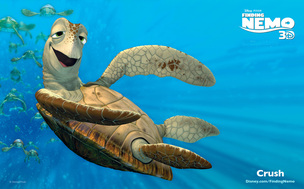
The totally awesome sea turtle, surfer dude "Crush" from Finding Nemo.
Comments

TRAINING DAY 4: WELCOME TO AQUARIUS!

5/22/2014

 
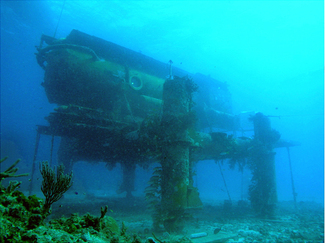
We dove in the Kirby Morgan helmets again today, but this time down to Aquarius! It was my first time to the undersea habitat, my future home, and it was surreal. I felt like a fish finding the toy castle in the fish bowl. 

Even though I'd viewed plenty of photos of the habitat before the trip, seeing the structure appear out of the blue (literally) and swimming alongside it was nothing like I could've imagined. Underwater for the last 21 years, it's a living reef, covered in corals, soft sponges, and other marine life. Fish swam everywhere, accustomed to divers' presence. We saw a goliath grouper, tarpon, snook, a sea cucumber, and many more marine creatures. 

Today Aquarius staff were installing equipment (including the microwave!) inside the habitat. I waved at them and they waved back through a port window. Other divers were outside cleaning the sides of the habitat. Two Bonnet Rouge cameramen joined us. 
Picture
It really does look like this! The Aquarius undersea habitat. Photo credit to NOAA.
Picture
Swimming up to Aquarius for the first time, I felt like a fish finding the castle in the fishbowl.
Picture
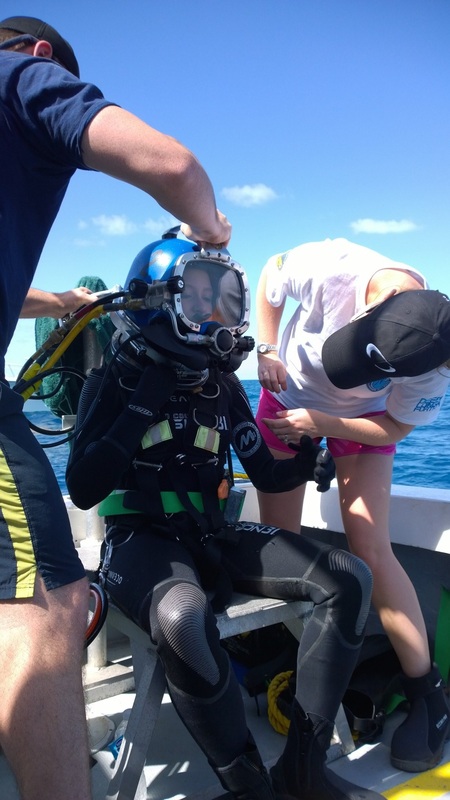
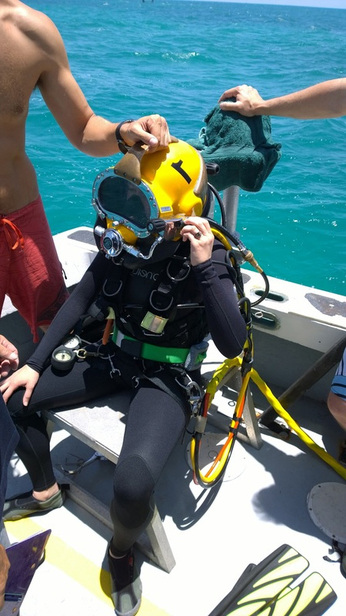
It takes a team to put this suit on! Thanks to Liz (right) and Navy diver Hunter for helping. Photo credit to F. Cousteau.
Picture
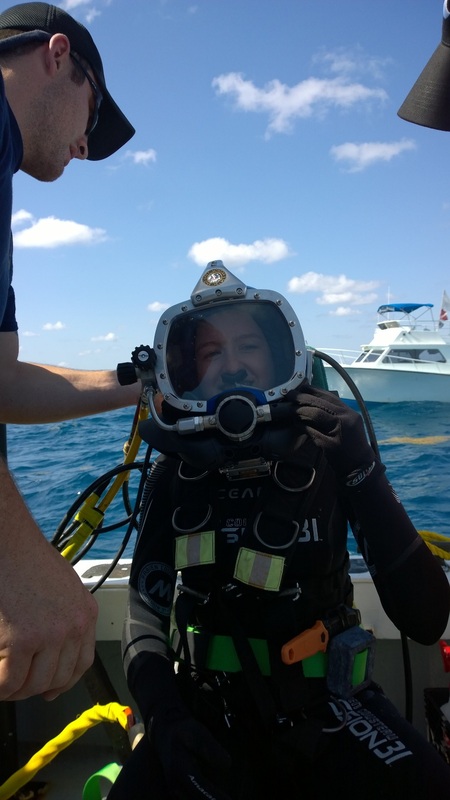
About to head into the water. It looks like I've a mustache, but that's just the nose clearing device. Photo credit to F. Cousteau.
Back on the dive boat, the aquanauts took turns operating the air supply box and talking with the diver in the water over the communications line. I really enjoyed being on the radio; it's fun to hear divers describe what they are seeing. 

Our gear from Oceanic arrived yesterday screen printed with the Mission 31 logo, so today we all wore matching fins, wetsuits, and booties. We looked like a team! More photos of the team gear to come. Also, more videos to come! Back at the house, the Bonnet Rouge team continued to edit footage from today. 
Picture
That's me! Descending to Aquarius. Caught on film by the Bonnet Rouge crew.
Picture
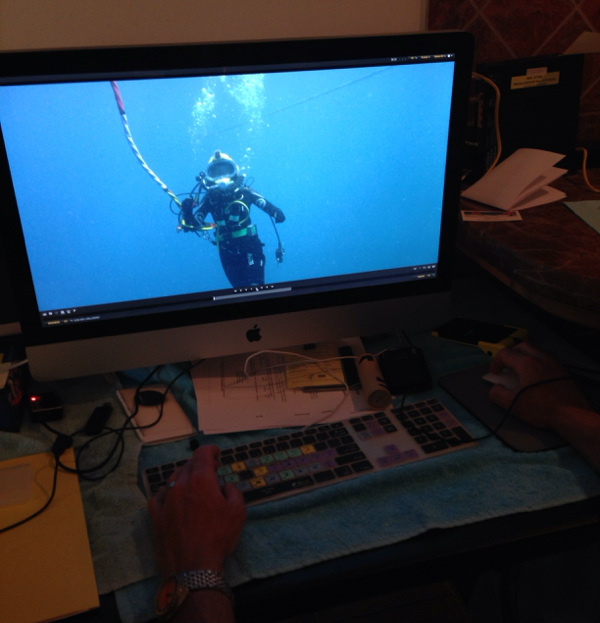
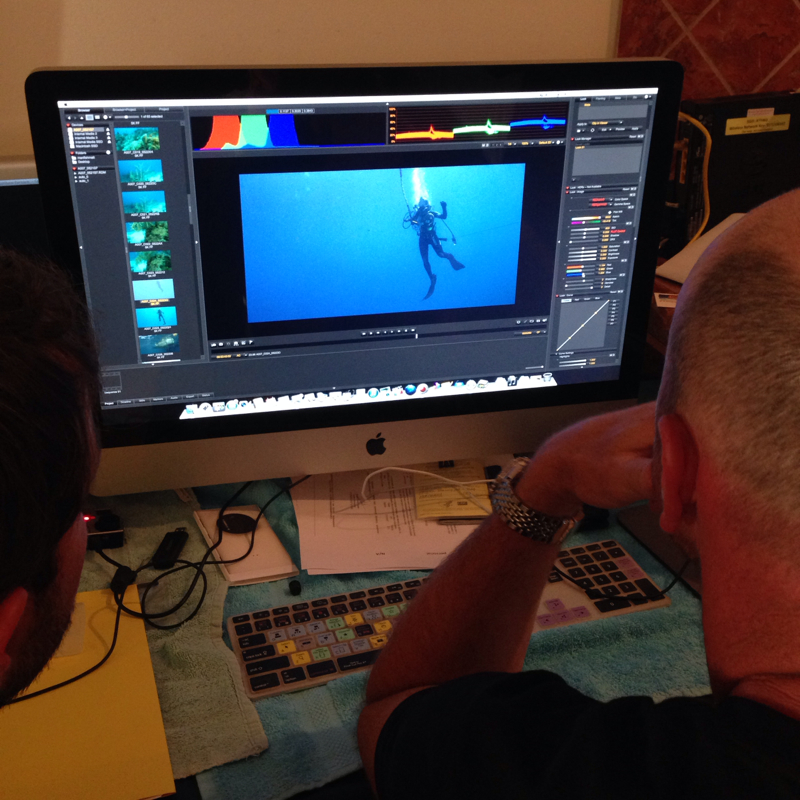
Matt editing footage from today. That's me on screen! There's much more amazing footage yet to come from the Bonnet Rouge team.
Here's a quick clip of my descent to Aquarius (with director's commentary), filmed by the Bonnet Rouge crew on the RED camera. The team is still hard at work editing footage from today.
Picture

More high speed video tests

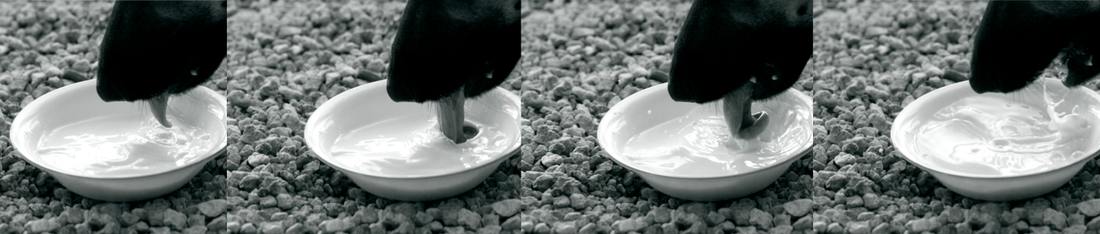
I've also uploaded a video (below) that we took yesterday with the Edgertronic high-speed camera. Sam, our Mission 31 mascot, proved a fascinating subject. We filmed her lapping up milk in the video below,at 700 frames per second. Who knew dogs tongues worked that way? Only after watching the video did I realize that their tongues curl backwards, forming a ladle shape when lapping up milk! 
Picture
Stills from Edgertronic high-speed camera footage of Sam, the Mission 31 mascot, lapping up milk. These were taken with a 50mm Nikon lens at 700 frames per second and a shutter speed of 1/1400 seconds.

Right now the plan is to tether the camera (via it's underwater housing) to the habitat for power and ethernet connection. But it's also possible to power the camera with batteries inside the case, and maybe connect the camera to a small screen inside the housing. I saw Eric Cheng do essentially this with an iPad and wireless router. I wonder if I could plug the camera's Ethernet into a Nokia smart phone via an adapter that went to the phone's miniUSB.
Picture
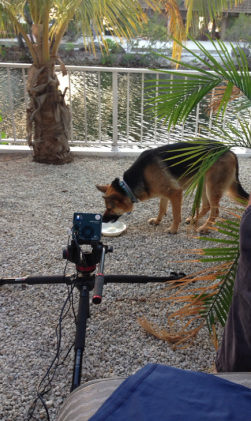
The scene: Sam in front of the Edgertronic.
Picture
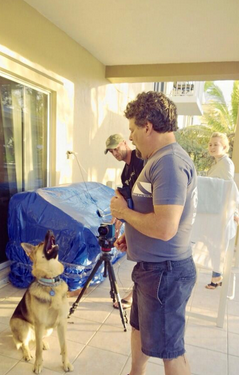
From left to right, Sam, Matt, Billy, and me filming a scene with our mascot Sam on the Edgertronic. Photo credit to Carrie Vonderhaar.
Tomorrow we'll dive back to Aquarius in the helmets and take a peak inside the habitat. After this week we should all be comfortable in the helmets and know what to do in the unlikely event that something goes wrong. I'm also working on adjusting the weights I use to dive in this gear. When diving you need extra weights to overcome your body's neutrally buoyant to reach the bottom. Fine-tuning how much weight to add is mostly a trial-and-error process. Today, to compensate for the 5mm wetsuit and new gear, I added 10-lb weights and sunk like a rock. Tomorrow I'll try 6 lbs. I can't wait to spend more time around the habitat. 

I'm exhausted.  Good night -- off to bed.

TRAINING DAY 3: "MOON" WALKING UNDERSEA

5/21/2014

 
The dive helmets we learned all about yesterday in the classroom got wet today. One-by-one all the aquanauts tested the helmets and practiced drills, including completely flooding the mask with water and then purging it, having our air cut off and then transitioning to emergency air supply. 

All of us have dived a considerable amount on SCUBA, but for each of us the helmet diving was a new and exciting experience. Because air to the helmet is supplied through an umbilical cord, there's no need for a heavy SCUBA tank. Instead, we have a small tank on our back only for emergencies. This is oddly freeing, even with the 30lbs helmet on your head. The "grounding" weight of the helmet also makes it easy to take off your fins and walk on the seafloor. I imagine the feeling is a bit like "moon" walking.  We're also in constant contact with the person regulating our air supply via a communications line in the helmet. 

The drills went smoothly for everyone, thankfully. Two Navy divers were helping us the whole time as well, in case anything went wrong. I found it hard to clear my ears while descending, which may be due to the fact that the helmet was designed for slightly larger heads . . . but I figured it out. 

I can't wait to spend more time in the helmet during Mission31. We'll wear this for up to three hours straight on some excursions underwater. 
Picture
Wearing the dive helmet, about to jump in! It's oddly freeing underwater despite 30lbs on your head because there's no need for heavy SCUBA air tanks on your back. The yellow umbilical cord supplies air to the helmet. That's my MIT brass rat class ring on my hand adjusting the helmet's knob! Photo credit to Marc Ostrick!

TRAINING DAY 2: KIRBY MORGAN DIVE HELMETS

5/20/2014

 
Picture
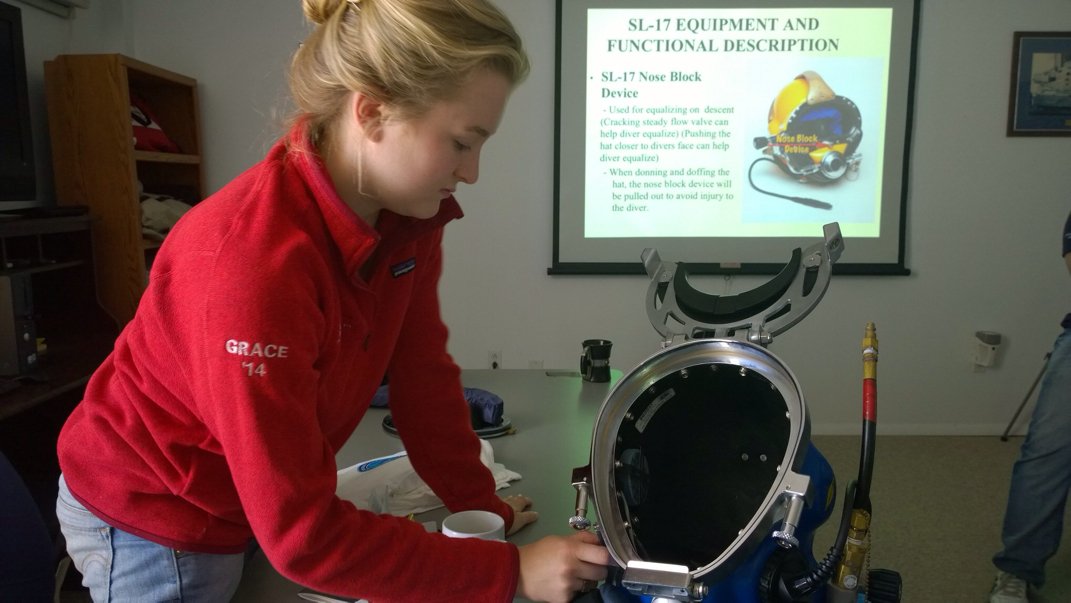
I'm examining the Kirby Morgan dive helmet, named after the manufacturer, that we'll be wearing for several hours a day while underwater. It weighs about 30lbs.
Today we spent a full day in the classroom. Aquarius' dive safety officer Roger Garcia taught us all about the dive helmets we'll be using on the mission. The helmet completely cover your head, surrounding it with air. It weighs about 30lbs, so it feels like a huge weight on your shoulders on land, but in the water you won't feel the weight. The helmet, also called a Kirby Morgan after the manufacturer, brings air to the diver through an umbilical cord, which can be up to 600ft long. Some of the aquanauts (Matt, Andy, Fabien) have used dive helmets before, but for the rest of us, it is a new and exciting experience. 
Picture
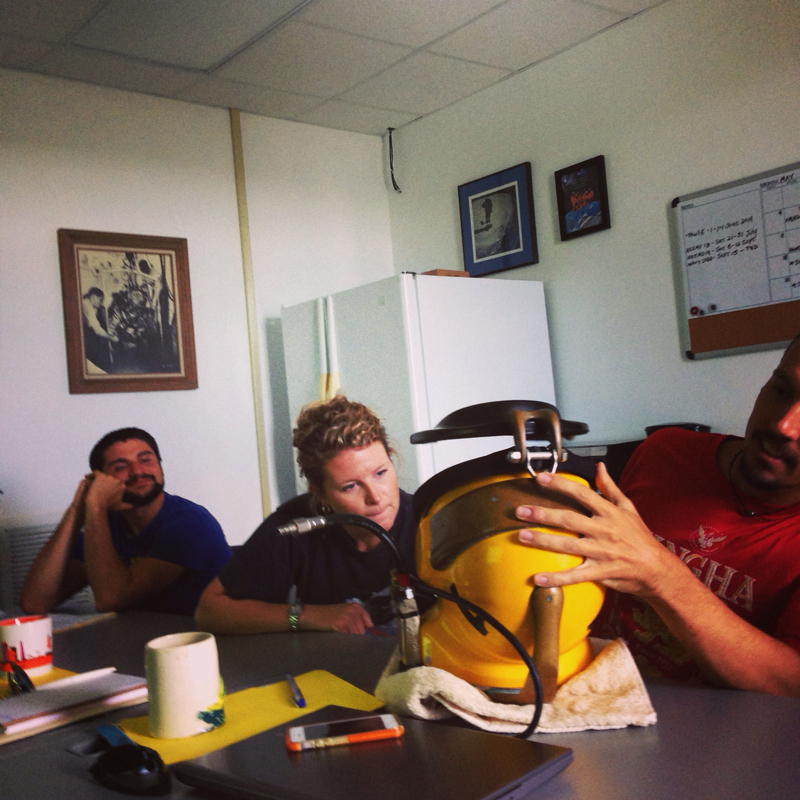
Adam, Liz, and Andy in the Aquarius classroom examining one of the dive helmets.
Picture
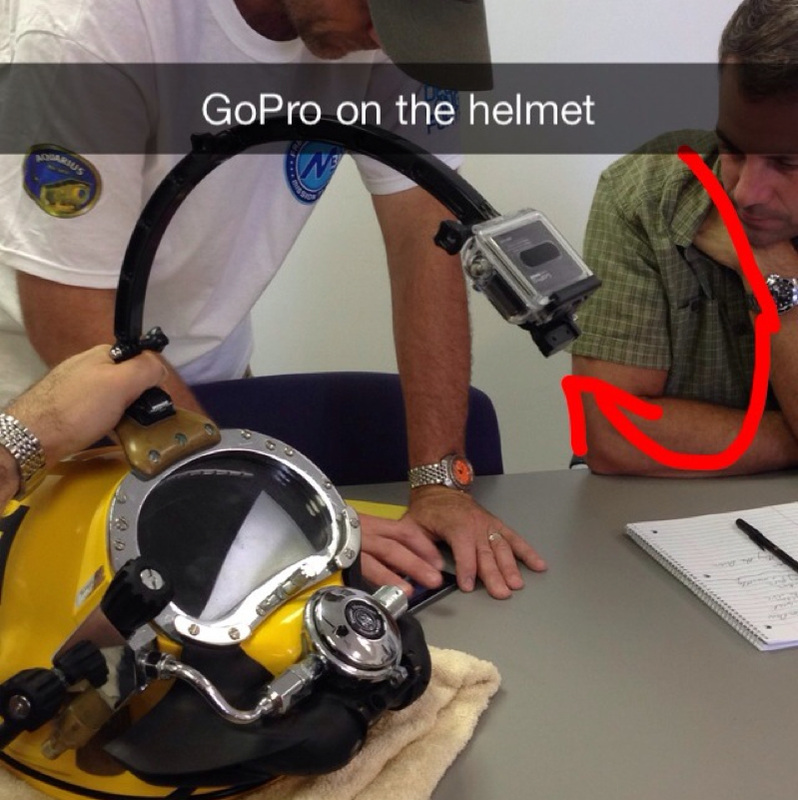
Matt and Kip trying to hook a GoPro camera to our dive helmet. That would be cool!
Picture
By the end of this week, we should all be able to use the dive helmets in our sleep. We'll also be prepared for every conceivable emergency situation, no matter how unlikely. One of the most important things to remember is to stay calm if something goes unexpectedly wrong. Freaking out is one of the worst things you can do underwater because you'll overuse your air supply and make less than best decisions. If you stay calm, however, it's all about remembering the training and/or following muscle memory. Team members at the control center are always monitoring us and in communication with us via the helmets, so we'll also be talking with them constantly about what things are going well, what aren't, or even what the weather's like on land.
Picture
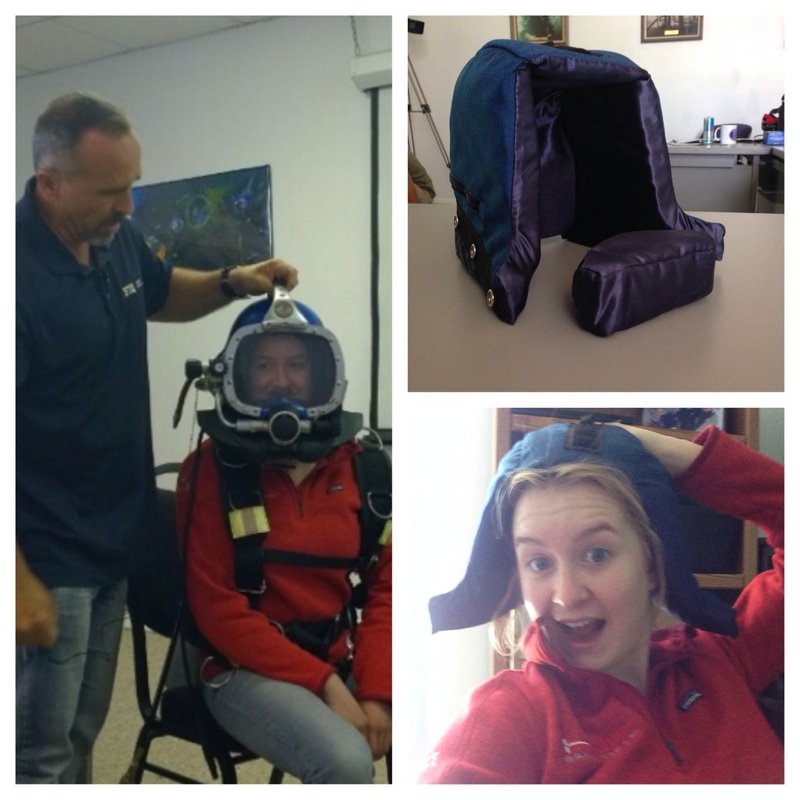
That's Saul on the left helping us try on the helmets in the classroom. Everything went smoothly first time! To make the helmet snug and comfortable we wear padding around our heads, as on the right.
Picture
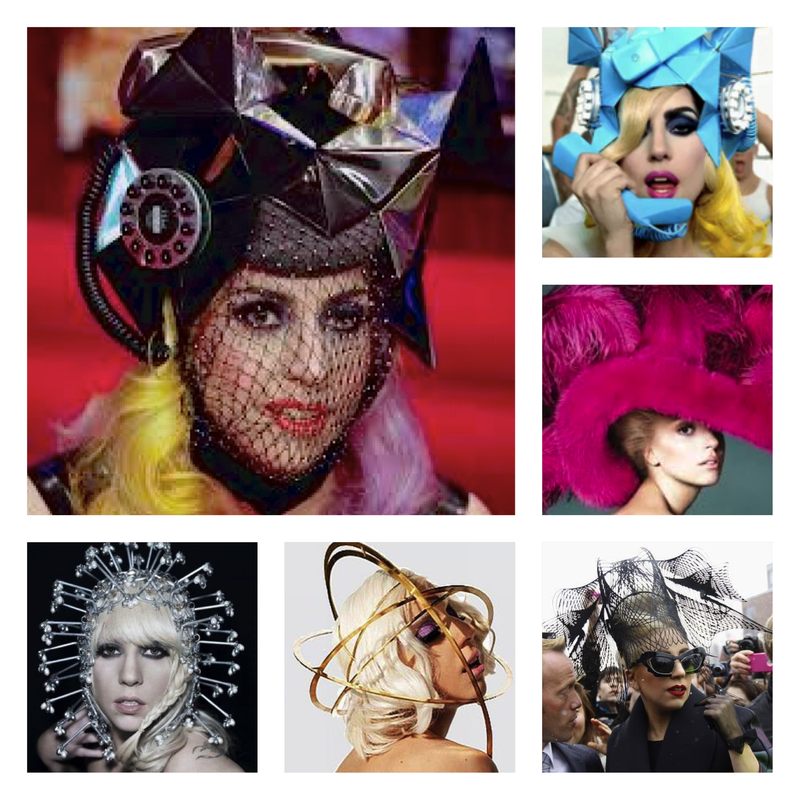
I could see Lady Gaga loving the Kirby Morgan dive helmet. She's a big fan of exotic headpieces.
Picture
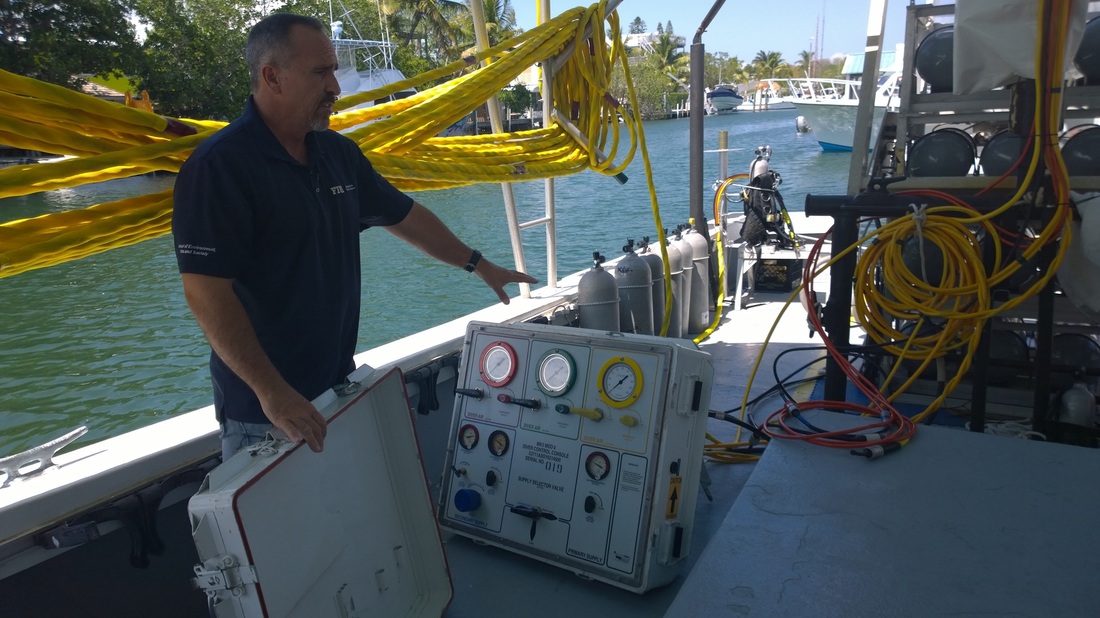
Roger showing us the dive boat control box. It regulates air supplied to the dive helmets.
Picture
This is an umbilical cord that connects to a dive helmet, bringing air and a communication line underwater.
Tomorrow we'll dive with the helmets and practice the drills we discussed today. That way everything will become muscle memory. One drill we'll do is to completely flood the mask with water (on purpose!) and then clear it with a purge valve. 
Picture
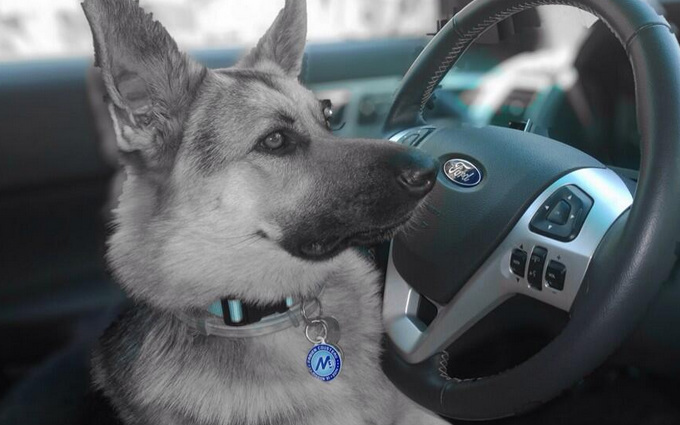
Spotlight to our official mascot, Samantha the German Sheperd! You can follow her on Twitter at @M31Shepherd. Photo credit to production team member Carrie Vonderhaar!

AQUANAUT TRAINING DAY 1: FITNESS & SCUBA CHECK

5/19/2014

 
Liz and I woke up at 7:00am, ready for a packed day of training. Billy Snook picked us up around 7:30am and drove us to the Aquarius Reef base, the building onland where Aquarius operations and management happen. We met the entire Mission 31 team, including the mission coordinators, topside crews, Navy support divers, and FIU scientists. After working with these people remotely for several months now, it was great to finally meet in the same room! The only people not there were the PR team and complete Northeastern and FIU science support teams. We spent time getting to know each other before reviewing the week's schedule.

Mid-morning the aquanauts and working divers headed to the pool where we passed swimming tests, including treading water for 10 min, swimming 400m, swimming 25m holding breath, and mask-snorkel recovery exercises.
Picture
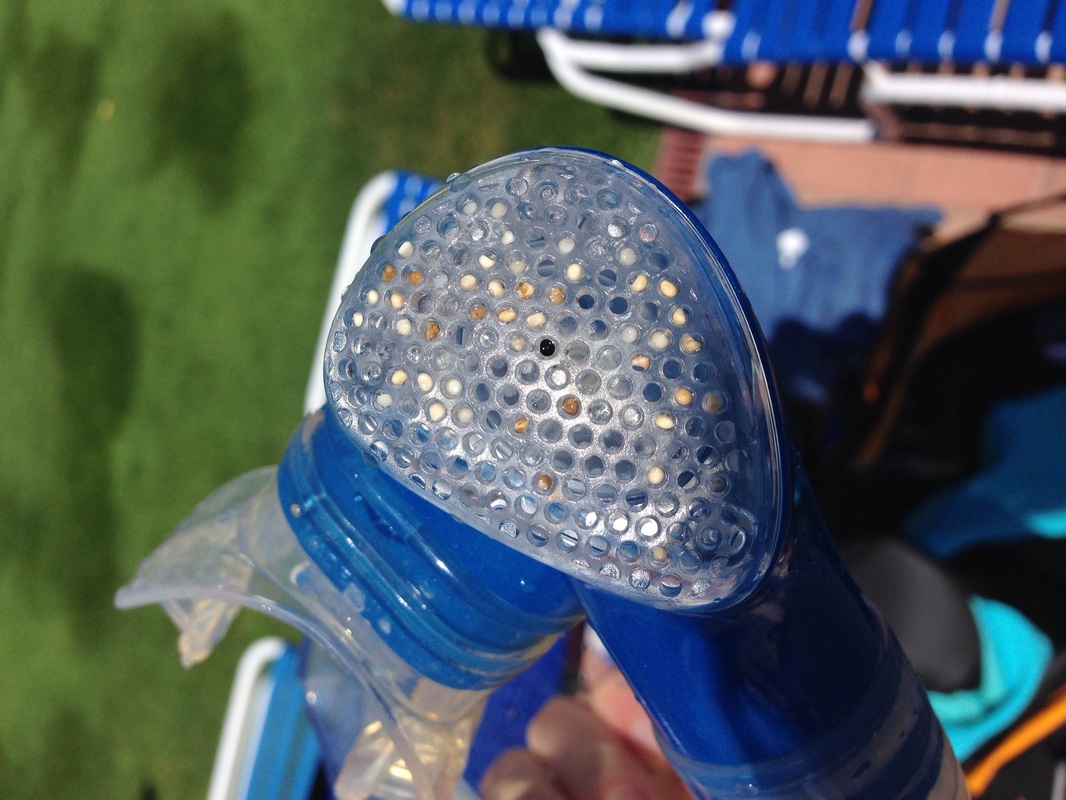
During the snorkel recovery test I realized pieces of sand from Hawaii are still perfectly lodged into my snorkel purge . . . not good, but they bring back great memories from last summer working for NOAA.
Back at the reef base (i.e., "control center") I chatted with David Peta who runs IT for Aquarius and was manning the watch desk. The watch desk has six display monitors showing information about Aquarius, including information about the health of the aquanauts, video feeds, and statistics on power consumption and air quality. 

Picture
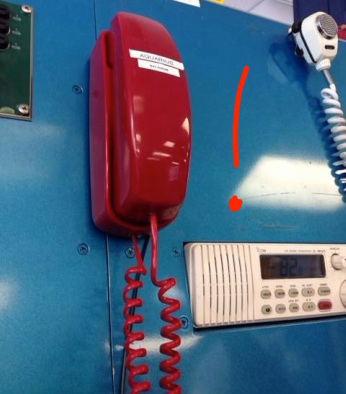
This ominous red phone connects directly to Aquarius.
Picture
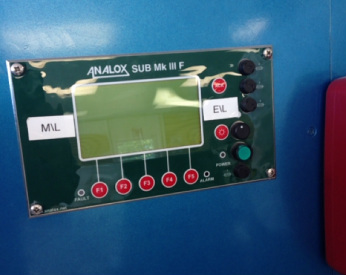
The "mother unit" shows O2 and CO2 data from the Aquarius habitat.
Picture
    
Picture
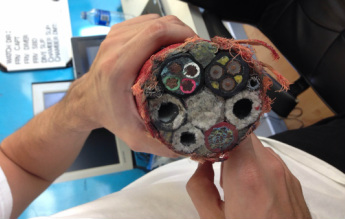
Slice of an undersea cable on display at the Aquarius Reef Base. Cables like these run throughout the seafloor and carry practically all international web traffic.
Picture
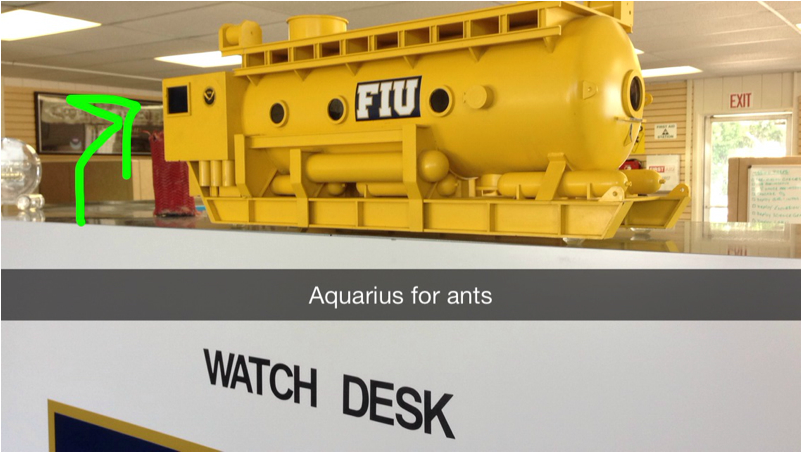
A model of Aquarius (where we'll be living next month!) sitting on the "watch desk" at command center.
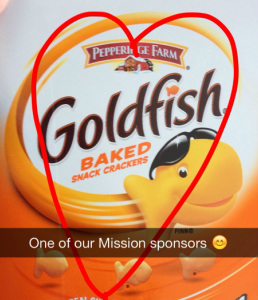
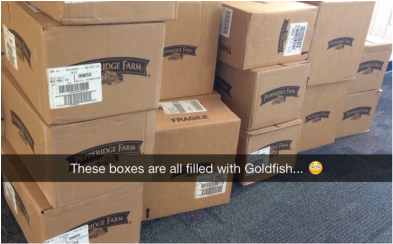
We also started eating some of the four dozen boxes of Pepperidge Farm Goldfish that arrived last week courtesy of our food sponsor, Campbell's.

I've been hearing from past aquanauts that your senses of taste and smell are dulled while living underwater. One group of researchers on Aquarius apparently did a study on it, but no one is sure where the results are. I thought I might as well do a quick study before leaving . . . and it might as well be Goldfish we taste test.
Picture
Picture
So many Goldfish!
Picture
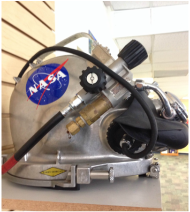
The diving hard hat we'll use on the mission was designed and built for the National Treasure movie, but they didn't use it after all! For the movie the designers added an extra-large viewing window and inside lights. The helmet in the picture at left is on display at the Aquarius reef base, similar to the one we'll be using tomorrow. It weights about 30lbs, so it's heavy on your shoulders. 

In the afternoon we completed checkout dives to test our basic SCUBA skills, such as taking on/off mask underwater, buddy breathing, and buoyancy control. We completed the tests on a coral reef called "hen & chickens," because a boat carrying chickens accidentally dropped a few of them nearby. Poor chickens . . .
Picture
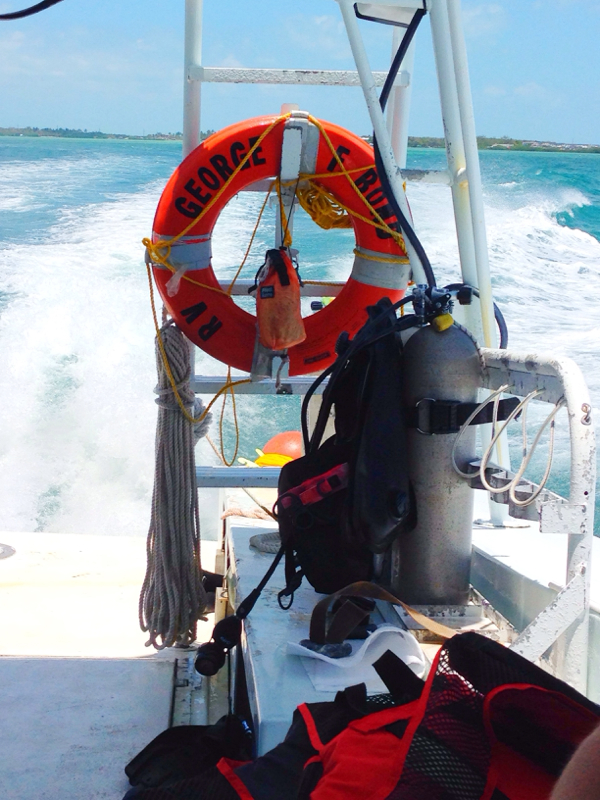
Onboard a boat named after undersea living pioneer George Bond for day 1 of aquanaut training.
Picture
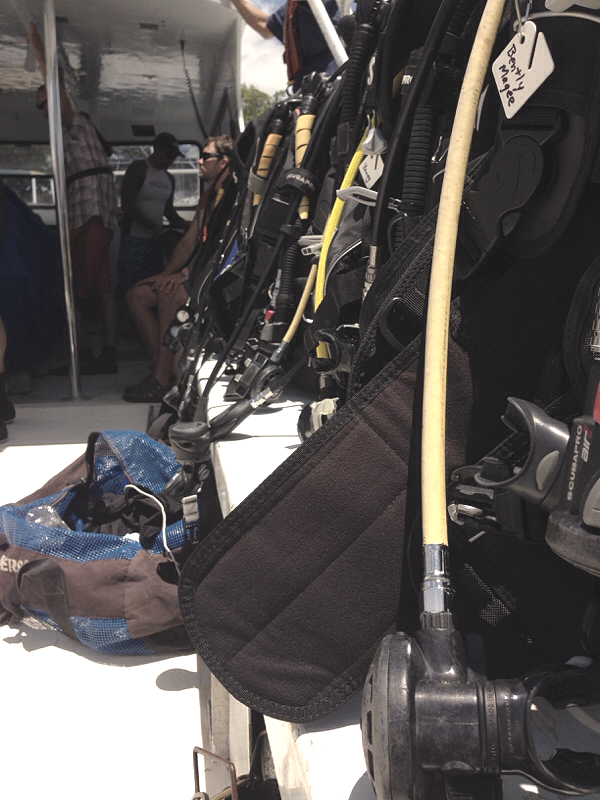
Gear lined up onboard.
Picture
Official Mission 31 screensaver on one of the desktops at command center.
The day of training wrapped up with a classroom debrief from Aquarius manager Roger about the decompression chambers available onsite. Afterward, the FIU aquanauts Adam and Andy returned with Liz and me to the big yellow house the team is sharing. After a few errands, we all drove the short way to mission headquarters to check on the rest of the crew. Everyone had work or research to catch up on. While Fabien filmed an interview inside, the rest of us worked productively on on laptops by the pool, enjoying the gorgeous weather.
Picture
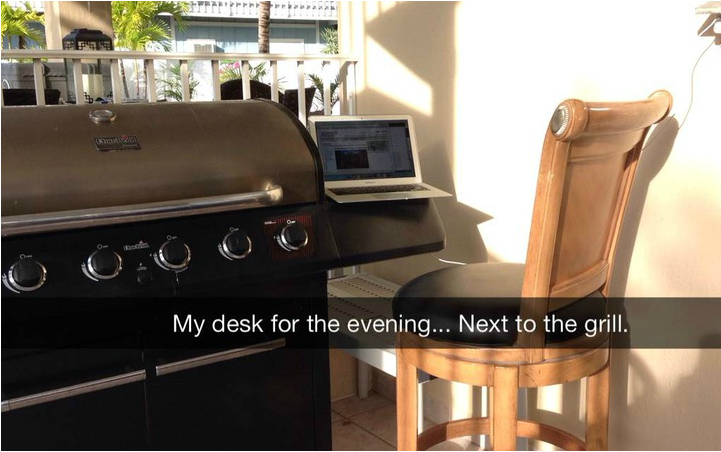
I moved next to the grill when my laptop needed charging.
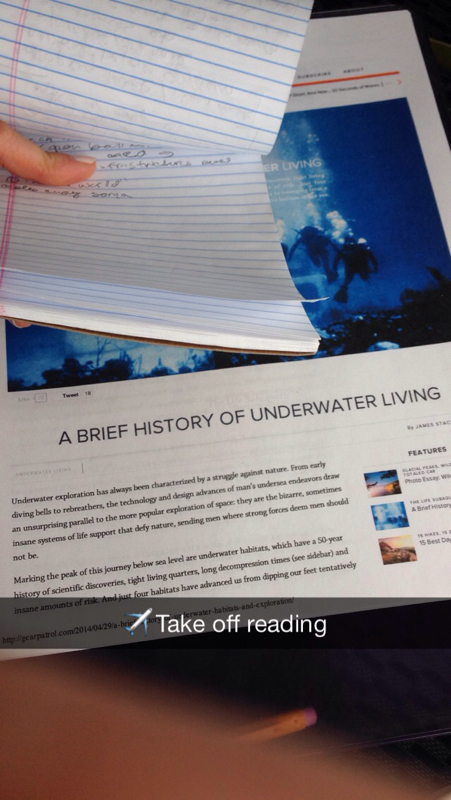
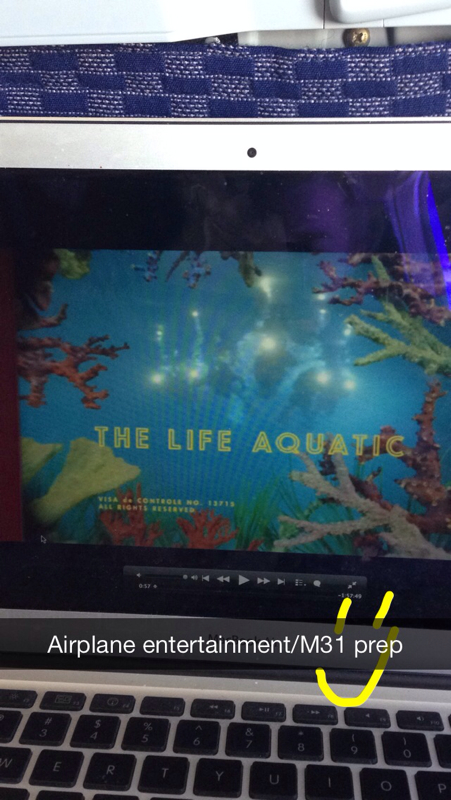
Tomorrow will be entirely in the classroom. We'll go over emergency protocols and be fitted for the neck-dam and vest that is necessary for the dive helmets. We need to make sure we're all comfortable with the MK-III light weight surface supplied diving system we'll be using. Before lights out in the yellow house, the aquanauts plan to wind down by watching the movie classic Life Aquatic, hands down one of my favorites -- a perfect way to end Day 1. 

ARRIVAL IN THE KEYS! 

5/17/2014

Comments

 
Aquanaut training starts tomorrow! We begin a grueling week-long training program off the Florida Keys tomorrow, including intensive fitness tests, acclimating our bodies to underwater living (much like astronauts train for space), and learning to handle the specialized equipment we'll use on the Mission.

Liz Magee (Northeastern scientist) and I traveled from Boston to Miami this morning. We met Fabien Cousteau (and his seven cases with 350lbs of camera equipment!) at the airport. He introduced us to team members Kip Evans, who'll live in Aquarius at the beginning of June, and Billy Snook, a dive shop owner and member of topside crew.

We packed into SUVs provided by Mission sponsor Ford and headed to Costco. We had an extensive shopping list from the team at the base, including food, various batteries and extension cables.


Picture
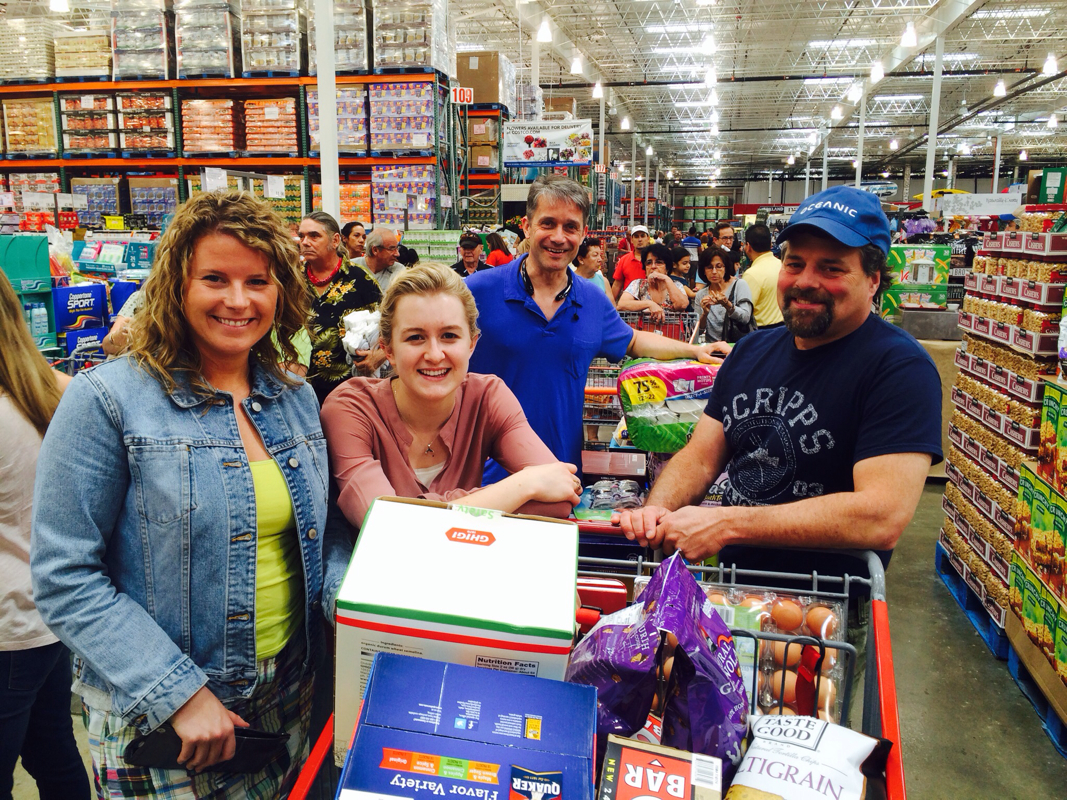
The crew at Costco, stocking up for mission headquarters. Left to right: Liz Magee, me, Fabien Cousteau, and Billy Snook.
After lunch we traveled to Mission headquarters on Islamorada. It's been a crazy week. In the past two days I finished my undergraduate studies with a final exam in Mechanics & Materials II on Friday, packed all my belongings into three bags, prepped the Edgertronic high-speed camera, and said goodbye to many friends. 

Mission headquarters is a house converted into a warehouse/meeting space/lodging. It's fascinating to see some of the equipment Fabien Cousteau's film production team, Bonnet Rouge, will use. I saw the underwater housing (about the size of a microwave) for the RED digital camera (the same type of camera Peter Jackson used to film The Hobbit), and looked at dozens of underwater lights, tripods, and other equipment. 

Picture
I finally got to try on the Mission 31 Doxa watch!
Picture
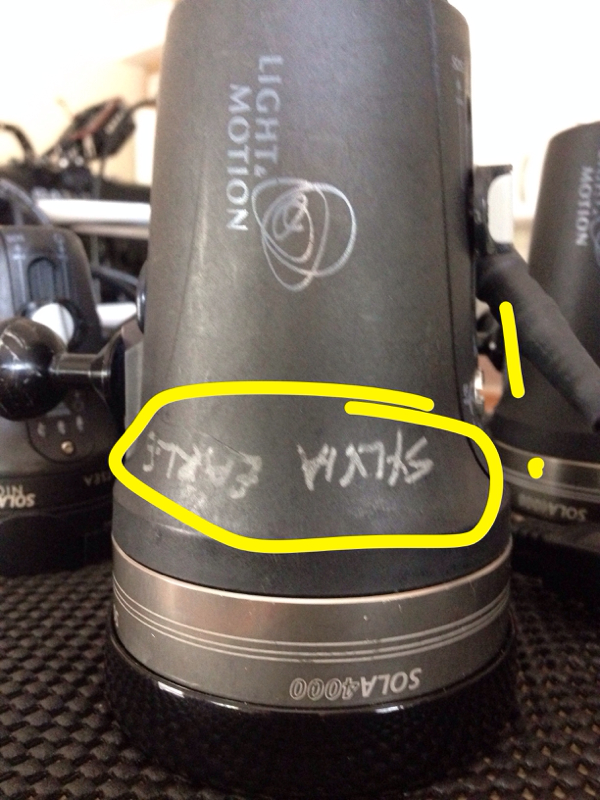
Among the M31 equipment, I spotted this light labeled by famous ocean explorer Sylvia Earle (who'll be visiting us in Aquarius in just a few weeks!). It's from one of her previous missions with Kip Evans. She works closely with the Cousteaus.
Picture
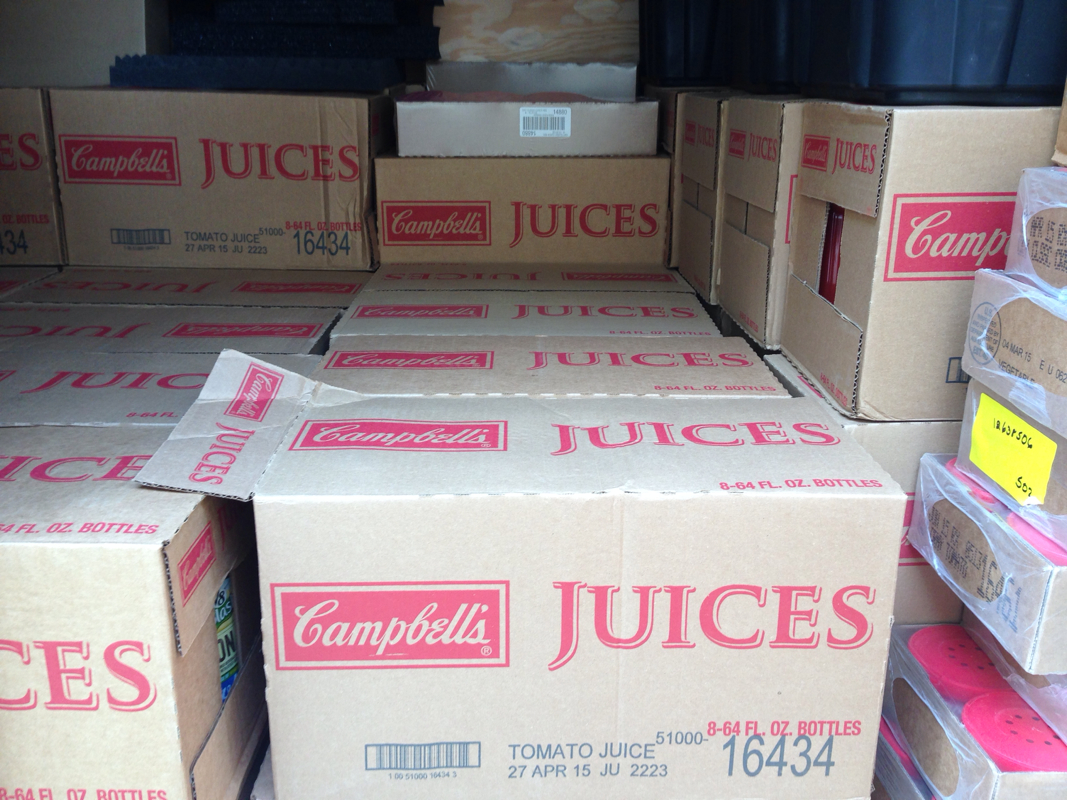
I've never seen so many boxes of canned soup! Campbell's, one of our mission sponsors, delivered dozens of boxes of juice, soup, and Pepperidge Farm products to the dive headquarters.
Picture
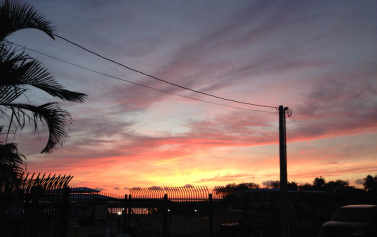
What better way to end the day than with a beautiful sunset over palm trees. Hopefully this is a good sign.
Tomorrow we start training, so we all need a good night's sleep! 
Comments

EDGERTRONIC HIGH-SPEED CAMERA TESTING

5/16/2014

 
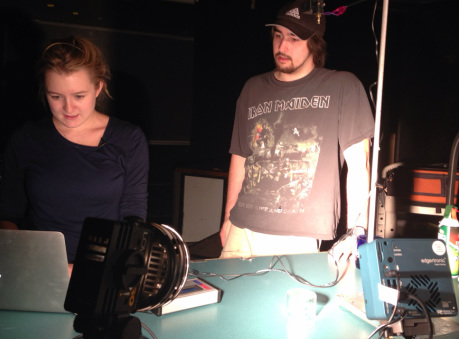
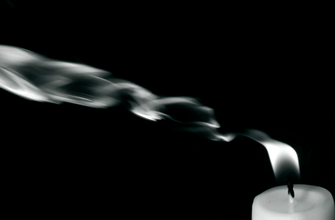
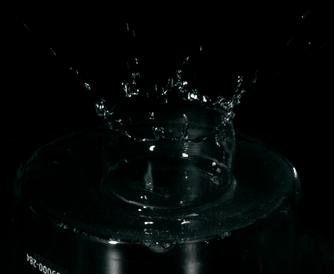
At the MIT Edgerton Center, Jim Bales, Kyle Hounsell and I tested the Edgertronic high-speed camera again. My goal was to become as comfortable with the camera as possible on-land before taking it underwater. It was my last chance to meet with the Edgerton Center experts again before heading to Mission 31 training this weekend! Also, an MIT videographer, John Freidah, filmed us working for a video he's doing on the Mission. We captured some beautiful footage of a candle flickering and water droplet, the kind of subjects "Doc" Edgerton recorded. One reason we're so excited about the Edgerton-Mission 31 connection is that Doc Edgerton worked closely with Jacques Cousteau on underwater photography. I'm still working on the underwater video camera casing for Mission 31.
Picture
Working in the MIT Edgerton Center with Kyle. We used the Edgertronic high-speed camera, in the lower right, to get the images and videos below. The room was dark except for a bright spotlight on the subjects. The images we captured are black and white. We chose the monochrome model of Edgertronic because it's more sensitive to light than the color camera and will therefore be better suited for underwater filming, where light is scarce.
Picture
Candle flicker image we captured with Edgertronic today. See the full video below from both the Edgertronic and a standard camera (for comparison).
Picture
Water drop image from Edgertronic camera today.
Check out how different the phenomenon looks filmed with a standard camera below compared to the Edgertronic videos above. 

NAHANT REVISITED

5/14/2014

 
Luckily I got to spend another day in Nahant. Today we had the last meeting with the entire Northeastern science team before some of us head to Florida for training. We spent the bulk of the afternoon going over the science overview for the team, and then hearing stories from Mark Patterson and Brian Helmuth about their past saturation diving experiences in Aquarius. I can't wait for the adventure to begin! 
Picture

RIP NEREUS: ONE-OF-A-KIND OCEAN ROBOT

5/12/2014

Comments

 
Something major in the ocean exploration community happened last Friday. We lost the Nereus HROV while it was exploring the Kemadec Trench in the South Pacific, one of the deepest trenches in the world, while on an incredible 6 mile dive. Nereus was a one-of-a-kind robot and a real loss.
http://web.whoi.edu/hades/a-sad-day/

Picture
Deep-sea vehicle lost 6 miles down. It imploded under the immense pressure of about 16,000 pounds per square inch at those ocean depths.
Comments

OFFSHORE TECHNOLOGY CONFERENCE, TEXAS

5/12/2014

 
Last week 100,000+ people and thousands of companies were in Houston for the Offshore Technology Conference (OTC), which is basically the Disney World of the offshore oil and gas industry. I was there as a student representative for the Marine Technology Society Council, along with the extraordinary Breezy Grenier, the other MTS student representative.  The Marine Technology Society, especially OTC Board member Chuck Richards (of C.A. Richards & Associates), deserve a huge thanks for welcoming Breezy and me at the conference. 
Picture
Picture
Picture
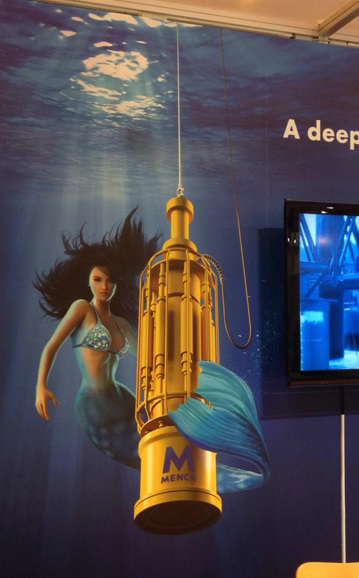
Most of the conference was geared towards oil and gas companies. I was more interested in underwater imaging systems. Bowtech Products Ltd put on a good show of their underwater cameras, LED lighting, connectors, and fiber optic multiplexers. There were also a number of impressive sonar imaging systems, e.g., by 2G Robotics. Most companies there are looking to make business connections with other businesses, so I'm really thankful when they're willing to chat with students, even though we're clearly not buying. 

Brian Salerno, Director of the Bureau of Safety and Environmental Enforcement, had interesting remarks on the conference from the perspective of a regulator: 

Your industry sets a very aggressive pace, you are the source of new ideas and technology.  The challenge for those of us who are regulators is to keep pace with you, and to understand the safety and environmental implications of this technology, so that offshore resources can be developed without incident. 
 
This then gets to the fundamental question of the role of the regulator, vis-a-vis the industry, and how we can collaborate in a meaningful way, all the while remaining true to our obligation to act first and foremost in the public interest. 


His full statement here. 
Picture
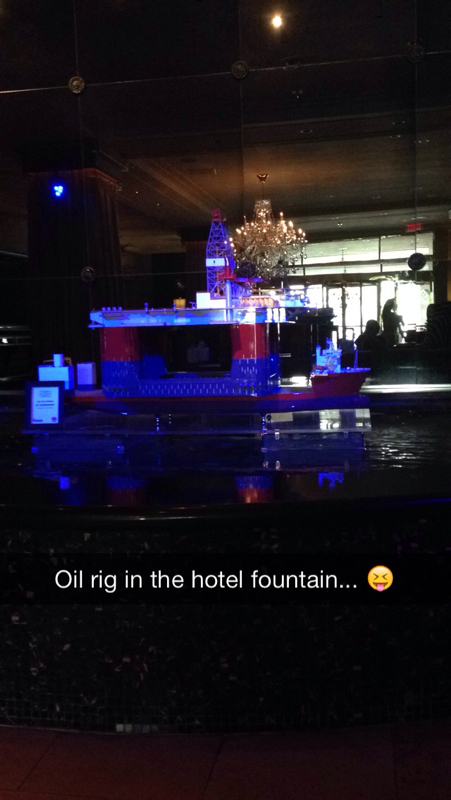
Interesting juxtaposition of the oil rig with the chandelier...
Picture
Effective advertising?? Posters at OTC, advertising equipment for subsea operations
I learned that the US government is extremely interested in a) the missing flight 370, and b) the Pacific garbage patch, but little else ocean related. These are by no means the biggest threats facing the ocean -- that list would start with overfishing, pollution, and climate change (which includes acidification). Frankly, it's scandalous that the US still hasn't ratified the Law of the Sea Convention that it negotiated more than 30 years ago. 165 other countries have passed us by!

The MTS council meeting was the day before the conference started, so we had time to explore the city, including the Natural History Museum. 
Picture
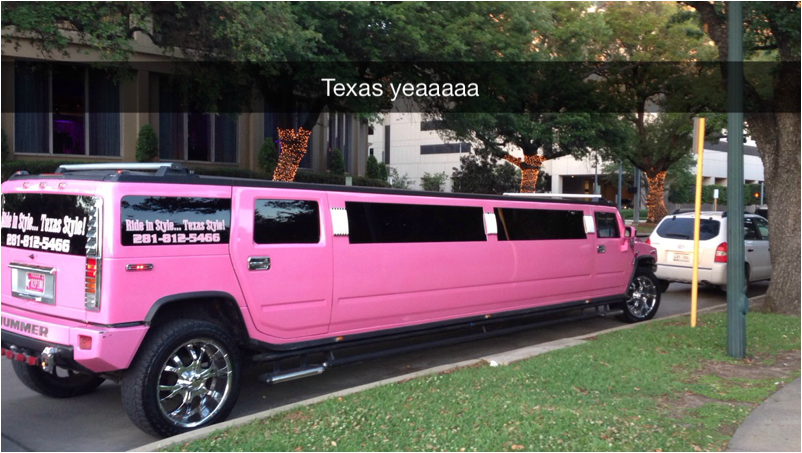
This was parked right outside our hotel... Ohh TX.
Picture
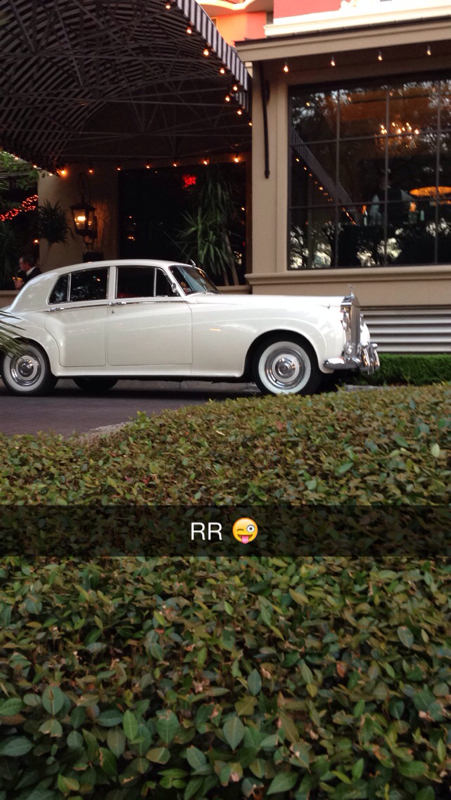
. . . so was this Rolls Royce.
Picture
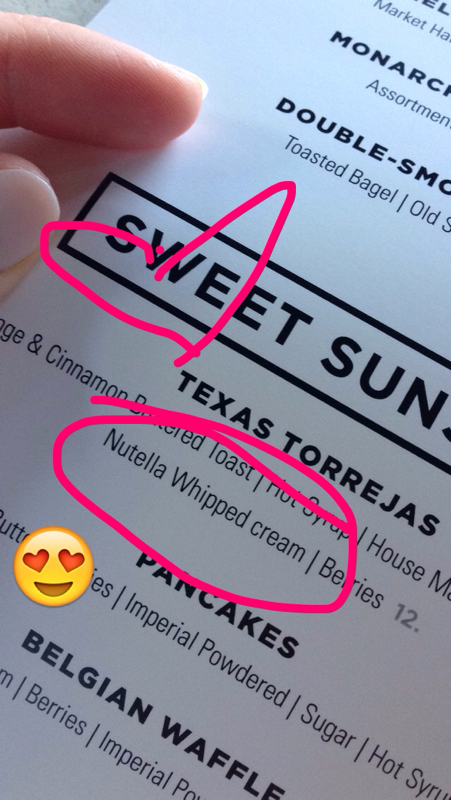
They know how to eat in Texas...
Picture
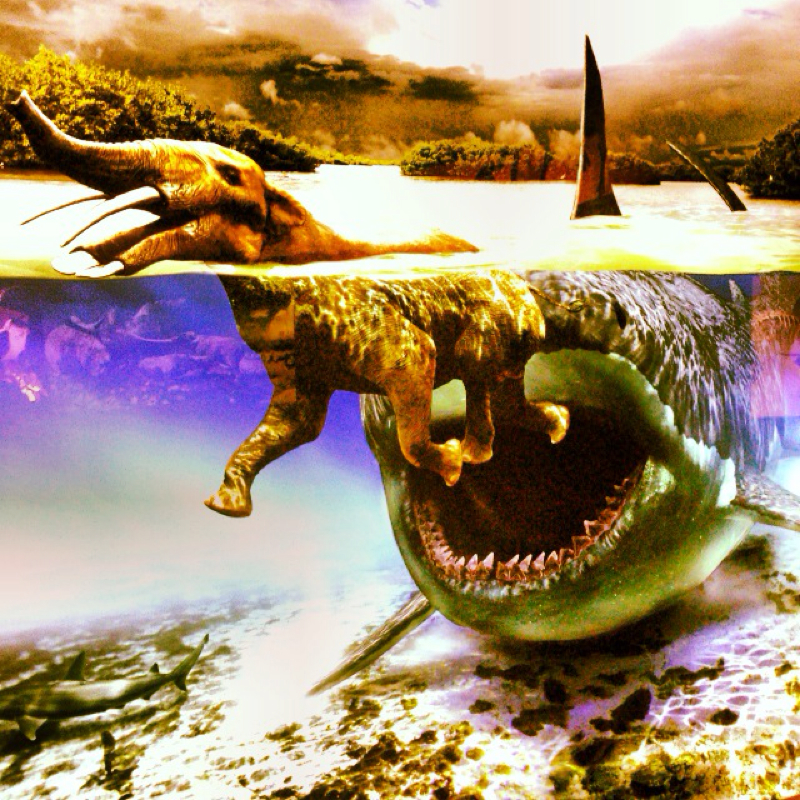
Now I see why kindergarteners are preoccupied with sharks. Apparently this actually happened.
Picture
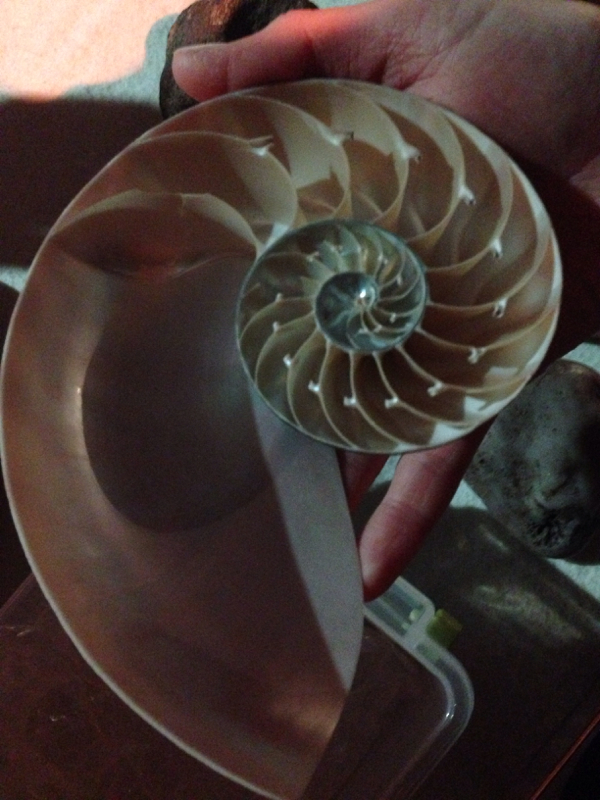
Real shell, made by mother nature. Reminds me of my calculus textbook.
Picture
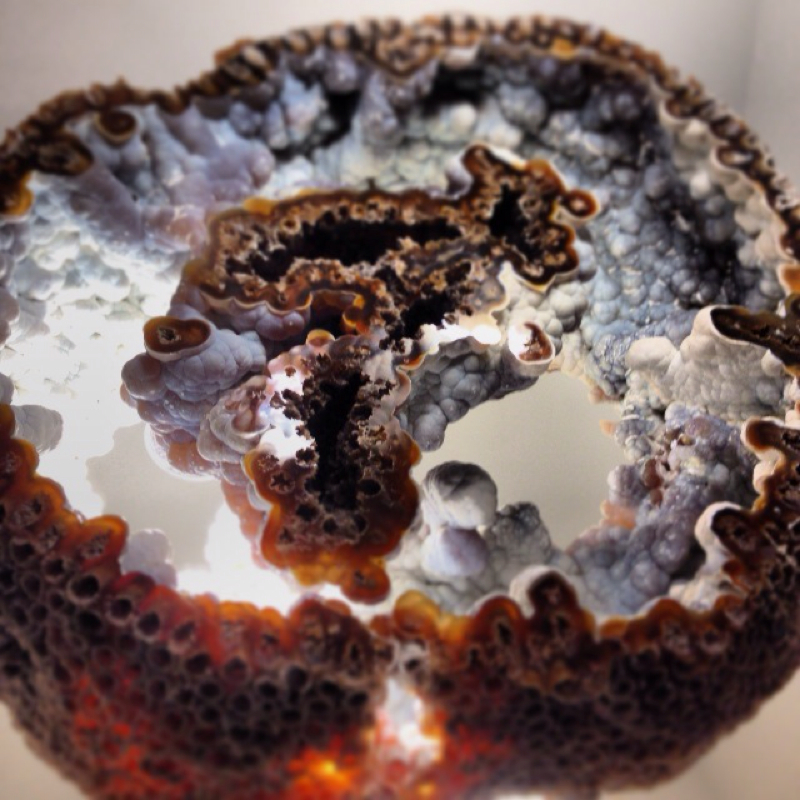
Fossilized coral on display at the Houston Museum of Natural History... Just beautiful.
Picture
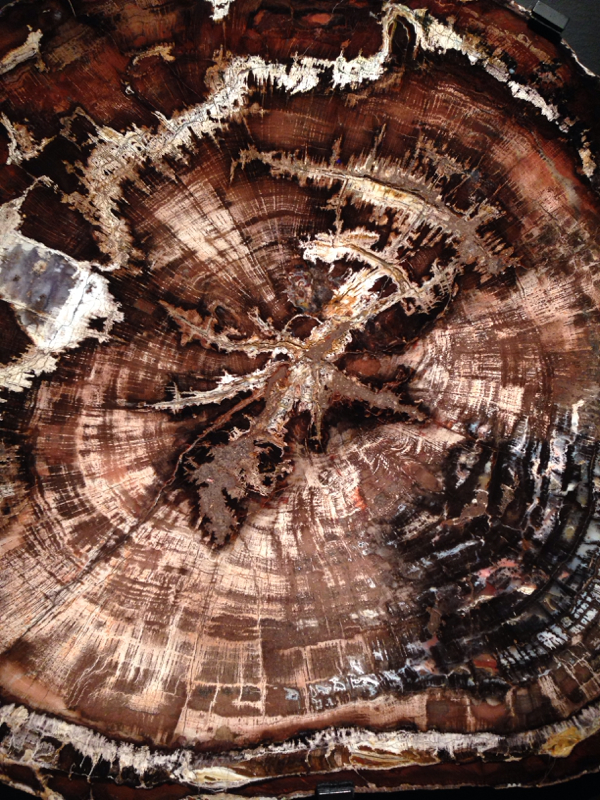
Fossilized tree trunk at Houston Museum of Natural History... Gorgeous.
Something interesting happened at dinner. I was talking about Mission 31 and from across the table someone quietly said "I worked for 5 years to get Aquarius shut down." I won't name names here but a fascinating conversation ensued about the relative value and merits of deep-sea research compared to other fields (say, hurricane prediction). I learned that the National Science Foundation (a major source of government science funding) now judges its grant applicants on the broader impacts of the research and its benefits to society (see broader impacts criterion).  The problem is that scientists, especially those doing cutting edge research, don't always know the impact of their research. Fourier, for example, struggled to fund his theoretical mathematics research on the Fourier transform. He died long before the results of his work (i.e., the Fourier Transform) were used as the basis for most telecommunications on the globe. 

The debate on who should fund what scientific research is huge. Should governments fund? Should private companies? If the government funds, will the private sector follow? I don't have answers, but I know something has to change. See "James Cameron says today's ocean exploration is “piss poor.”  He's right.
Picture

EDGERTRONIC HIGH-SPEED CAMERA ARRIVED

5/11/2014

Comments

 
Yesterday the Edgertronic camera arrived at the MIT Edgerton Center. We aim to use the camera underwater during Mission 31 to catch grouper fish feeding behavior. It will certainly be a challenge using the camera underwater. More updates on that later. Yesterday we were able to catch a balloon popping in slow-motion with the camera at MIT (see video at right). 
Comments

HAPPY MOTHER'S DAY!

5/11/2014

 
To all mothers of all species! And to my own wonderful mother, of course!
Picture

I WANT TO DIVE IN THE MALDIVES

5/2/2014

 
Gorgeous video of a dive in the Maldives. Shout out to EunJae Im. 

YESTERDAY AT NORTHEASTERN MARINE SCIENCE CENTER

4/30/2014

Comments

 
Picture
Picture
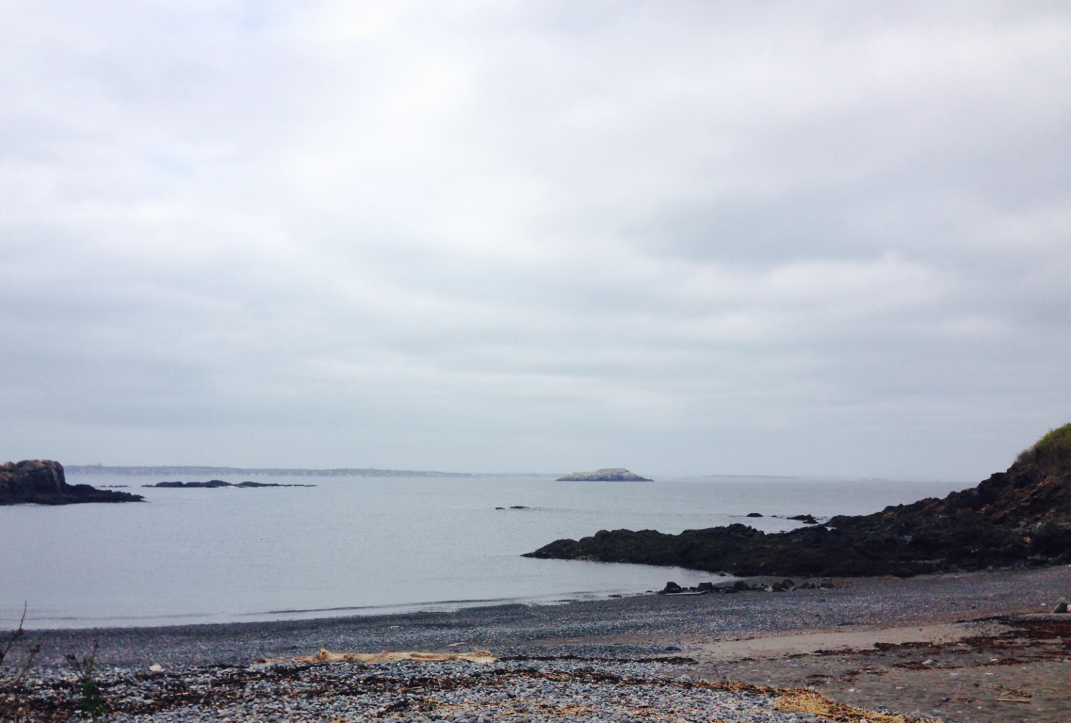
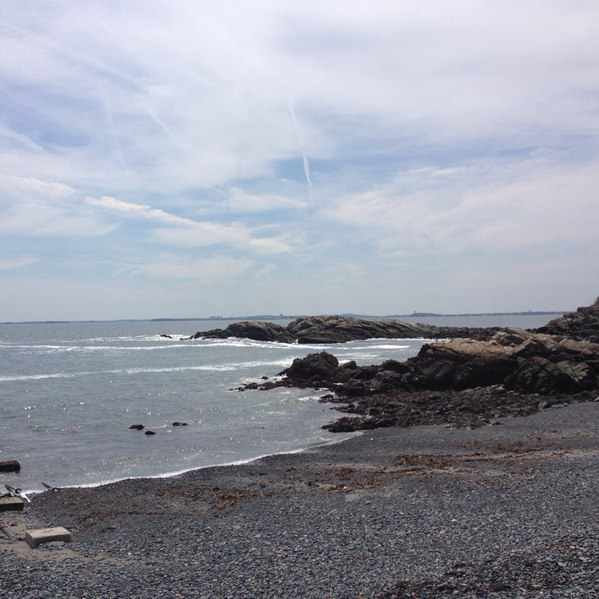
The beach, right on the Northeastern Marine Science Center campus... gorgeous.
I took the train from Boston to Nahant yesterday to spend the day with Brian Helmuth, Mark Patterson, and their team at the Northeastern Marine Science Center. Brian and I will saturate at the same time on the latter half of Mission 31. Although we'd chatted over the phone and exchanged numerous emails, we hadn't met in person until today. I'm absolutely honored to be diving with him.

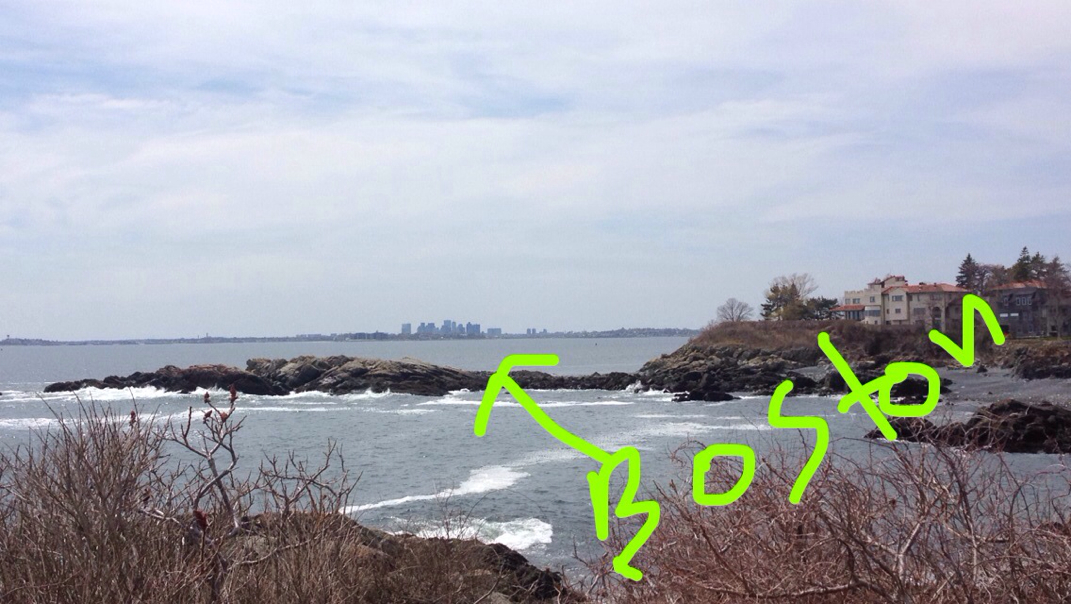
As much as I love Boston, it was nice to get out of city for a bit. Nahant, an island north of Boston, has a gorgeous rocky shoreline, and in the distance you can see the Boston skyline.
Over lunch I had the pleasure of meeting Dr. Joe Ayers, inventor of the RoboBee, RoboLobster and others. His group builds biomimetic robots you can see in the Smithsonian. 

In the afternoon I joined the Northeastern team on our weekly Mission 31 science conference call. The conference call was more fun this week with the focus on dive helmets and the schedule. Everyday I get more excited for the mission.

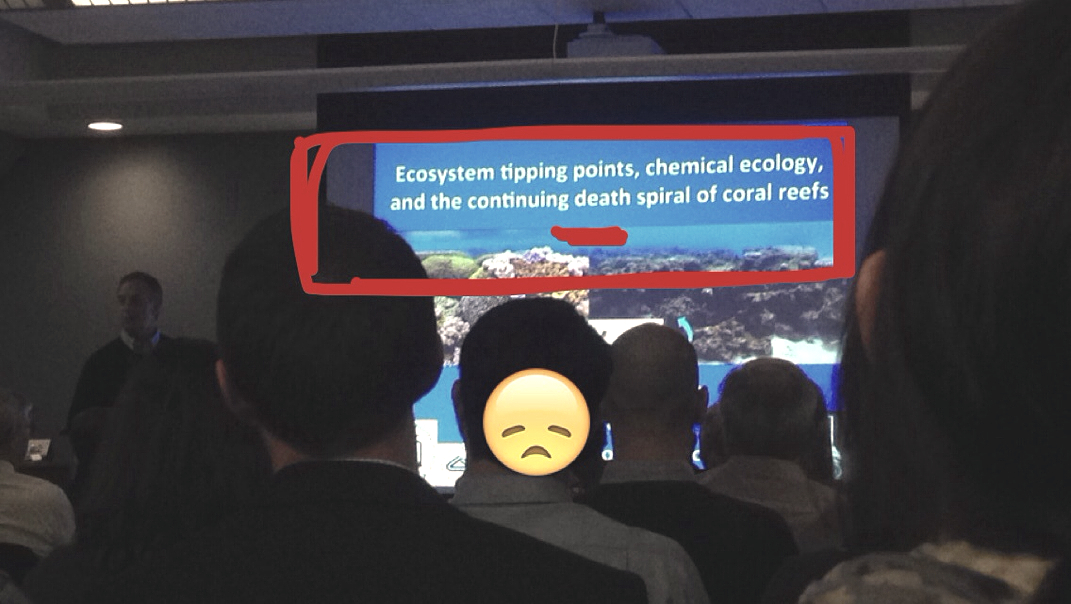
Yesterday was also the annual Riser Lecture at the Marine Science Center. The guest speaker, Dr. Mark Hay, made his hour talk fly by in what seemed like a few minutes. Mark's topic was the current health of coral reefs.

Picture
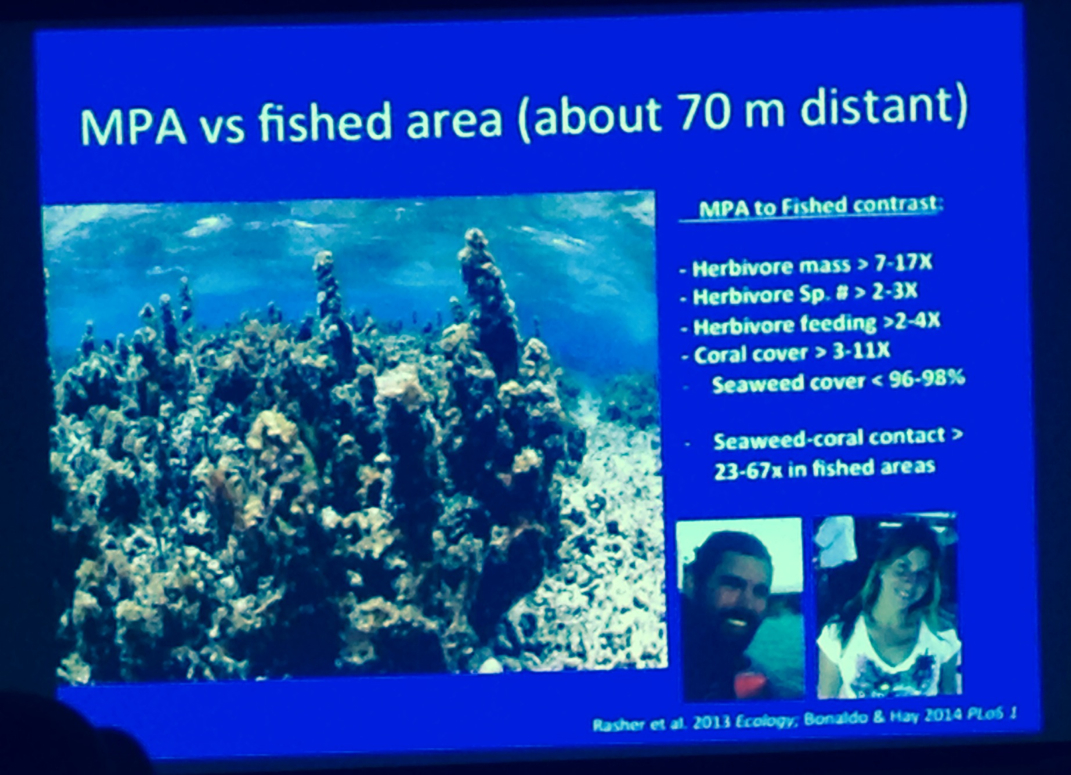
The rightfully alarming title of Mark's talk: "Ecosystem tipping points, chemical ecology, and the continuing death spiral of coral reefs." I was prepared to walk away completely depressed, but Mark gave us some reason for optimism. His team showed how Marine Protected Areas improve coral health drastically. They may be our best hope for saving the ocean.
Astounding numbers!  I've long been convinced Marine Protected Areas are the key improving our oceans health, and Mark's talk confirmed this notion. He cited a number of studies, including his own, that quantify the effects of marine protected areas (i.e., without fishing, dumping, etc.) on ecosystems. The numbers are astounding, summarized in the slide below.
Picture
Dr. Sylvia Earle is also a huge proponent of Marine Protected areas, and her TED Talk on the topic is excellent. She raised over $17 million with that excellent speech! 

Dinner following the Rise Lecture was fancy and fun. I can't wait to spend more time with Brian Helmuth and his team in Florida. 
Comments

NOW YOU CAN BUY CLOTHES MADE FROM ALL THAT PLASTIC THAT'S POLLUTING THE OCEAN 

4/30/2014

 
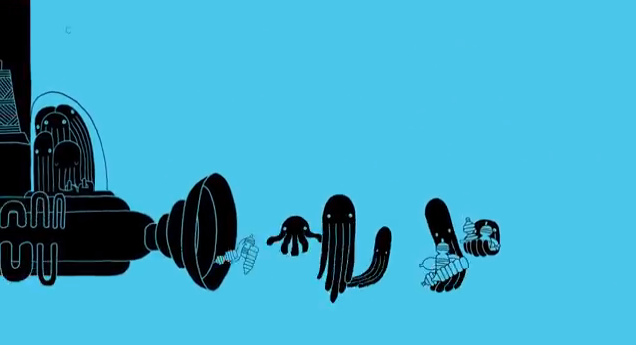
Well, not quite yet . . . but soon! Artist Pharrell Williams (yep, the guy who sings Happy) is starting a hip clothing line made from recycled plastic from the ocean. It's not too clear how they're doing this (I'm curious on the engineering details, of course . . . Maybe they're going to use this 19-year old's idea !?). The video showing animated octos making the clothes certainly doesn't explain, but it must be possible . . . 

Speaking of celebs who want to help the ocean . . . Leonardo DiCaprio and the President of Iceland, Olafur Ragnar Grimsson, (link to his 2014 save-the-ocean speech) are also doing great things for the ocean. I hope more celebs will follow to spread awareness of the urgent need for ocean conservation!  

Pharrell's animated video with Raw for the Oceans and Bionic Yarn says the clothing line will be available August 15. 
Picture
In Pharrell's video, animated octos throw plastic bottles into an underwater machine that makes clothing! I'm curious about the actual plan . . . (Maybe this is the actual plan.)
Picture
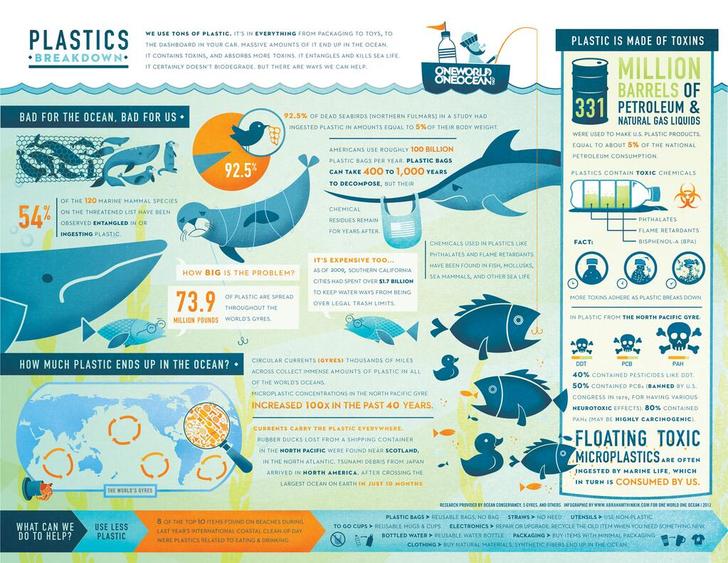
How much plastic is in the ocean? Way too much. This infographic by One World One Ocean explains.

More Grace Under Pressure blog posts here.

CHARRED EMMYS

4/29/2014

Comments

 
"[W]e found the Emmys!!! Charred and tarnished, yet still standing now seemingly reaching for rescue." 
- Ferro Productions blog
Today I chatted briefly with a production company that might help spread the word about Mission 31. More information on that later. . . I just wanted to share their incredible story. The company's office and storage building recently caught fire, ruining all their equipment. I can't imagine how devastated the team must have been, but they've remained incredibly upbeat and optimistic. The photo at right shows their charred Emmys, which now have even more of a story associated with them. It reminds me of one of my favorite quotes: "When you think you may fail, you are often the closest to success." 
Picture
These Emmys survived a devastating fire and acquired a new beauty in the process. They remind me to be optimistic. (Photo courtesy Ferro Productions)
Comments

INSPIRING HIGH SCHOOL Students ABOUT MARINE ROBOTICS

4/24/2014

 
I spoke at STEMspiration today to a group of high school students in D.C. So honored to be part of a great line up of speakers: 
Picture
Picture
From the STEMspiration site: 
STEMspiration is the first STEM (Science, Technology, Engineering, and Mathematics) conference of its kind - a completely student-led event bringing together leaders, doers, makers and thinkers of the highest caliber. STEMspiration has been crafted by the USASEF Youth Advisors as an independent initiative to promote powerful ideas and collaboration in the STEM world.

Who is STEMspiration for, you might ask? Frankly, it is for anyone who cares deeply about the future of science in our society, and how we will encourage rising generations to fearlessly jump into the fray of innovation and discovery. Students, teachers, policy makers, non-profits, inventors, academics, and anyone else will find a place at STEMspiration. While the event will be taking place at McKinley Tech High in Washington D.C., it will be live-streamed for easy access to anyone who has access to the internet.


The STEMspiration Speakers:
Keynote by U.S. Secretary of Education Arne Duncan Bill Drayton: Founder and CEO, Ashoka
Stephan Turnipseed: President Emeritus, LEGO Education
Adam Garry: Manager of Global Professional Learning, Dell
Joe Palca: Science correspondent, National Public Radio
Grace Young: Aquatic robot scientist, MIT
Jim Meeks: Board of Governors, Jefferson Awards
Steve Culbertson: CEO, Youth Service America
Kaya Henderson: Chancellor, Washington DC Public Schools
Picture
Ritankar Das: Founder of See Your Future, the youngest university medalist in Berkley history, Oxford MSc candidate for Bioengineering, and generally nice guy.
Jack Andraka: Winner of the International Science and Engineering Fair for work on a new detection tool for certain cancers, advocate for open access and pokemon master in the works.
Jonny Cohen: Inventor of Greenshield, Forbes 30 under 30 twice, Mechanical engineering student at Columbia, makes them busses work better.
Adora Svitak: Author at age 7, curator of TEDxRedmond, champion and advocate for world hunger, short-story connoisseur.
Omar Abudayyeh: Researcher, MD/PhD candidate at Harvard/MIT, entrepreneur and published scientist. He can see in cells what others cannot.
Sara Volz: Intel Science Talent Search grand winner, published researcher, created super-algae for alternative fuel from her bedroom, MIT student.
Param Jaggi: Founder of EcoViate to make green products widely effective and available, discovered effective algae bio-reactor at 14, looks pretty great in lab goggles.
Parker Liautaud: Explorer of the great Arctic and Antarctic, fighter for the environment, TIME magazine 30 under 30 list, he can get you to the North or South Pole, and he can get you home.
Erik Martin: Game Designer and education activist, works on games that help people and society, founder of The Edvengers Super Hero PAC, is a fire mage in his spare time.
Picture

PRE-K OCEAN STUDENTS

4/23/2014

 
Picture
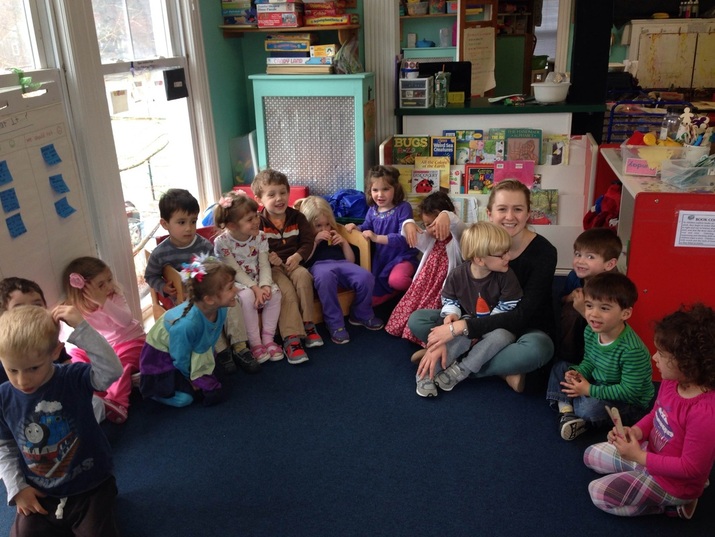
One group of pre-kindergardeners at the Tobin School.
Kids are so fun. Today I talked with about 40 pre-kindergarten students (as young as 3 years old!) at the Tobin School about the ocean and living underwater. They were excited about everything, from Mission 31 to the fact that my necklace had a whale on it. Unlike the kindergarten through third grade students I talked with in the fall, pre-schoolers are a bit too young to understand the full concept of a question. They did, however, tell me tons of stories. One girl even told me she wanted to come on Mission 31 and be a SCUBA diver when she grows up. This made me happy!

I got a lot of "what if" questions, but mostly they told me stories about the water or swimming pools. I love their imaginations. They asked:
  • What would happen if you met a shark and made it angry? 
  • How do you get food? How do you get drinks?
  • What if a shark ate your food?
  • What if a shark visited you? 
  • How big is the house? Is it bigger than a T-rex?
  • If it was Easter underwater, would all the eggs float? 

And told me stories, such as: 
  • "I saw a pink fish once. It had eyes but it couldn't talk."
  • "I have a swimming pool." (. . . and then everyone talked about swimming pools.)
  • "I went to the ocean once with my mom." (. . . and then stories about going to the ocean.)
  • "I have a SCUBA diver bath toy." 
Cats SCUBA diving? One student asked if there would be cats underwater. I have no idea why they asked, and I answered no, we wouldn't have cats, but I thought of this video (left) of a SCUBA diving cat. It's hilarious. (Yes, someone put their cat in a tiny SCUBA suit. And it worked!) 

Preschool compliment!  I also received what's potentially the hugest complement you can get from a preschooler. One girl told me I looked like Elsa (a Disney princess, at right). She even asked if I was wearing Elsa's shoes. I was flattered.   
Picture

OCEAN ROBOTICS: SKYPE IN THE CLASSROOM

4/23/2014

Comments

 
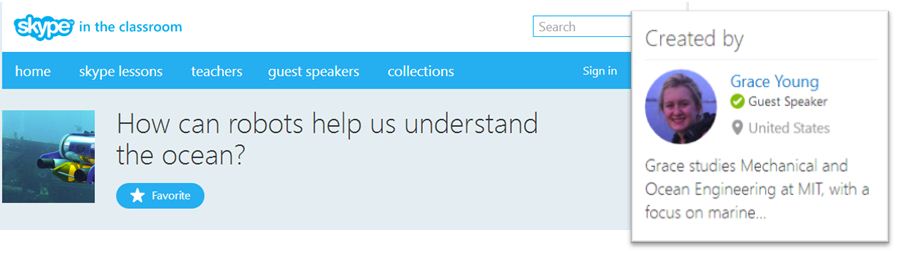
How Can Robots Help Us Understand the Ocean? I'm enjoying creating Skype in the Classroom lessons about the marine robotics and the ocean, and interacting with teachers and students. 
Picture
Comments
<<Previous
Forward>>
    Picture

    Author

    Dr. Grace C. Young  (BS MIT, PhD Oxford) is a research engineer, aquanaut, and explorer currently working at GoogleX. She lived underwater for 15 days as a scientist and engineer on Fabian Cousteau’s Mission 31, and is a National Geographic Explorer. 

    Blog Highlights: 
    1. No Engineer is an Island
    2. Mission 31 Highlights
    3. Sailing Across the Atlantic 
    ​3. Return to CERN

    Tweets by @grace_h2o
    ​INSTAGRAM

    RSS Feed

    Categories

    All
    Arts & Science
    Conservation
    Coral Research Mission
    Edgertronic
    Marine Robotics
    Mission 31
    Mission 31 Training
    Ocean Reports & Facts
    Ocean & Space Science
    Outreach
    Research
    Sailing & Adventures
    Sea Creatures

Powered by Create your own unique website with customizable templates.